

A Dot on a Map Is Not a Strategy: Meet Capiro’s District Nexus
District Nexus turns client footprint, federal spending, policy relevance and relationship context into district-level intelligence your team can actually use
Every government affairs professional has been asked some version of the same question:
“What do we have in this member’s district?”
It sounds simple.
The answer usually requires a congressional map, a client spreadsheet, USAspending, committee rosters, a CRM search, and a small archaeological expedition through old emails.
We thought that was a strange amount of work to answer a pretty basic question.
So we built District Nexus.
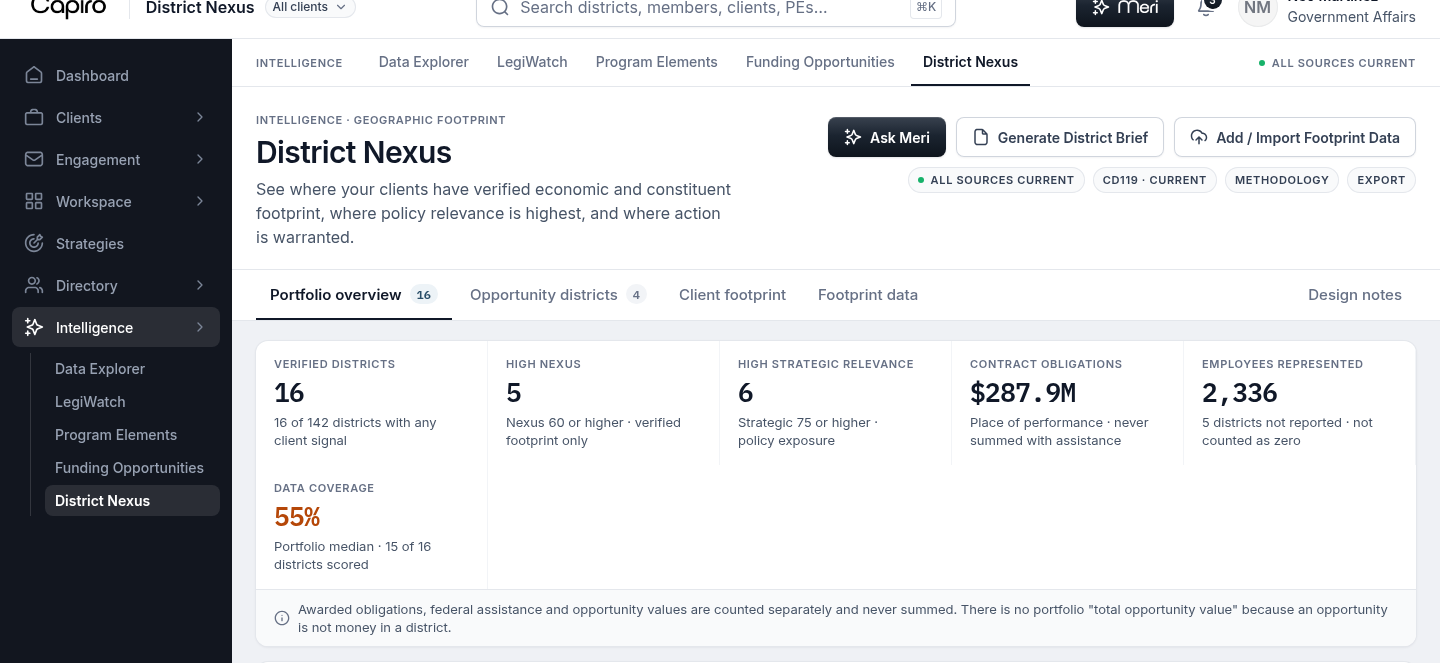
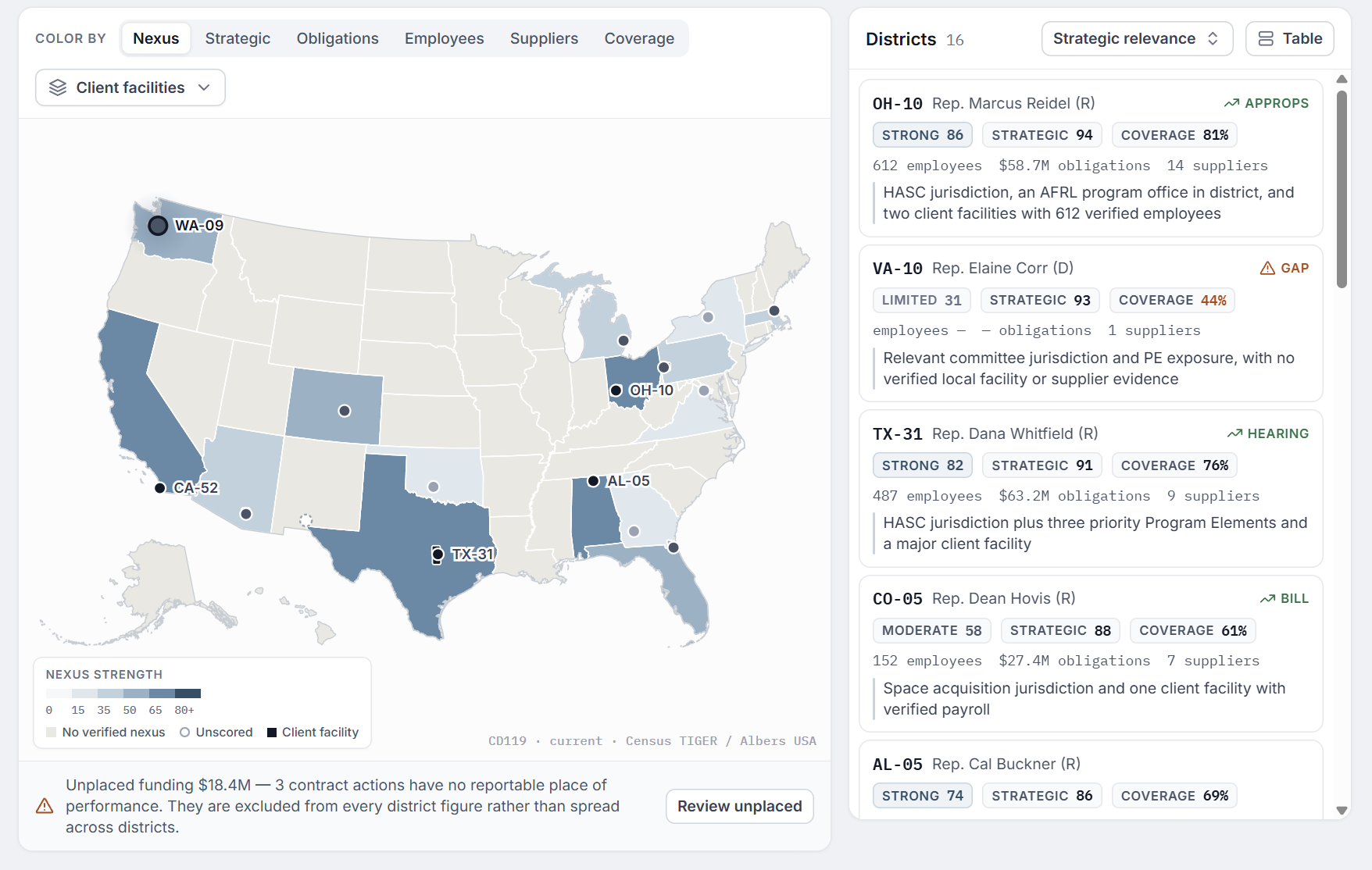
District Nexus starts with geography, but it does not stop at geography. It is designed to answer the questions that actually matter:
Why does this client matter to this district? What is economically or politically at stake? Why does this policymaker matter to the client? And what should the government affairs team do next?
In other words: a dot on a map is useful.
A defensible case for action is considerably more useful.
Start with the portfolio, not the scavenger hunt
District Nexus gives teams a portfolio-level view of where clients have verified footprint and where the underlying data is strong enough to use.
Facilities. Employees. Federal contract obligations. Suppliers. District coverage. Representation.
All in one place.
Just as important, the system is deliberately opinionated about what not to do.
Different categories of federal dollars are not mashed into one giant, impressive-looking-but-meaningless number. A missing employee count does not quietly become zero. A funding opportunity is not presented as money already won. Unplaced spending is not sprinkled around a map like confetti.
A pretty map is easy.
A map you can comfortably put in front of a client, a congressional office or your managing partner is harder.
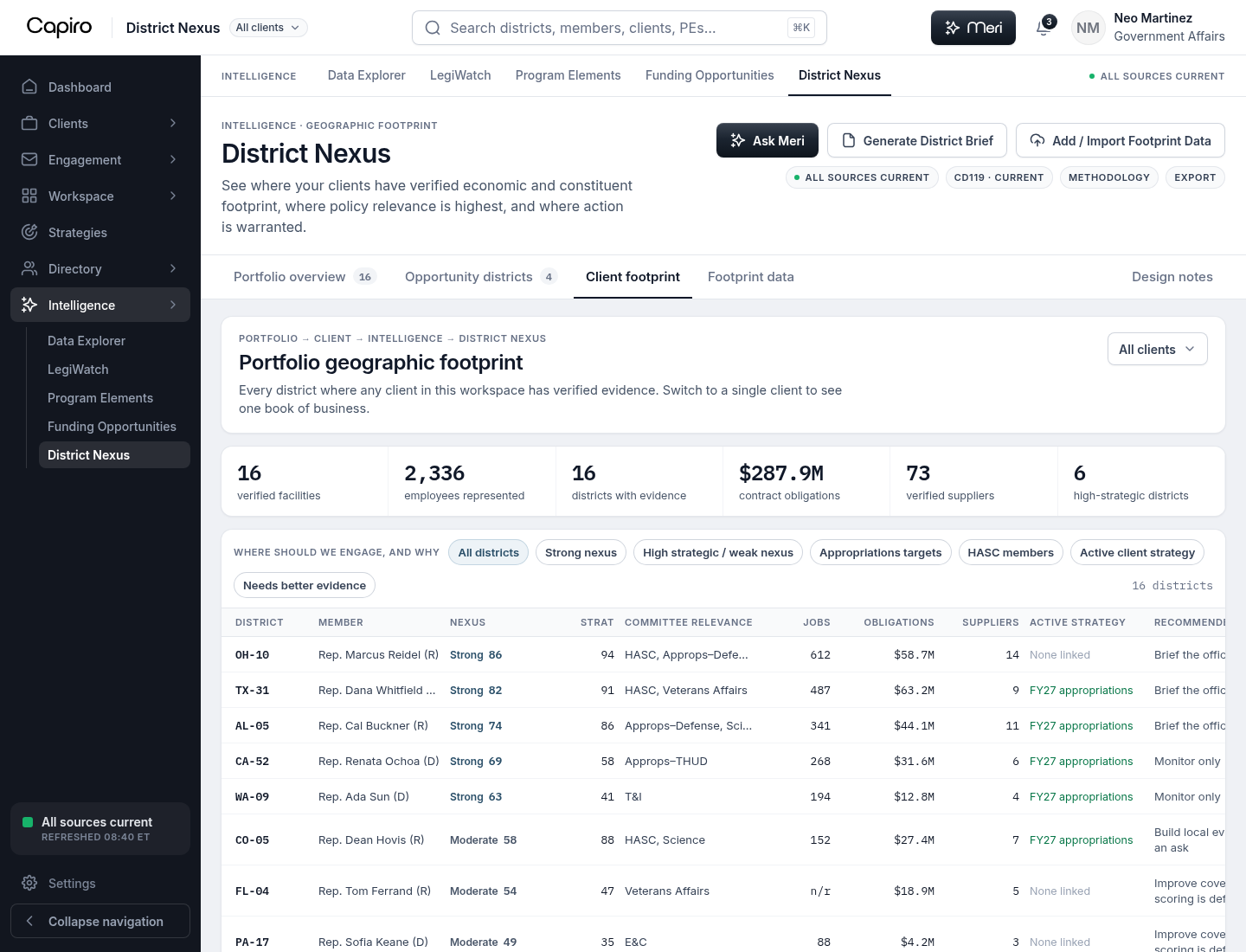
The portfolio view can then become an engagement list: which districts have strong nexus, which members sit on relevant committees, where active strategies already exist, and where the evidence needs work before the team walks into a meeting.
That changes the question from:
“Where are our clients?”
to:
“Where should we spend our time?”
Footprint and strategic relevance are not the same thing
One of the most important ideas in the new District Nexus experience is refusing to make one score do two completely different jobs.
Nexus Strength asks: What verified economic or constituent footprint does the client actually have here?
Strategic Relevance asks: Why does this district or policymaker matter to the client’s objective?
And Data Coverage asks the question software too often avoids:
How confident should we be in what we are looking at?
Those distinctions matter.
A member may sit on the committee that controls a client’s priority program while the client has very little verified local footprint. That does not mean the office is irrelevant.
It means you have a case-building problem, not a relationship problem.
Likewise, a client can have a major facility and hundreds of employees in a district where there is no immediate policy ask. That is still a relationship worth maintaining—but perhaps not where the team should spend tomorrow morning.
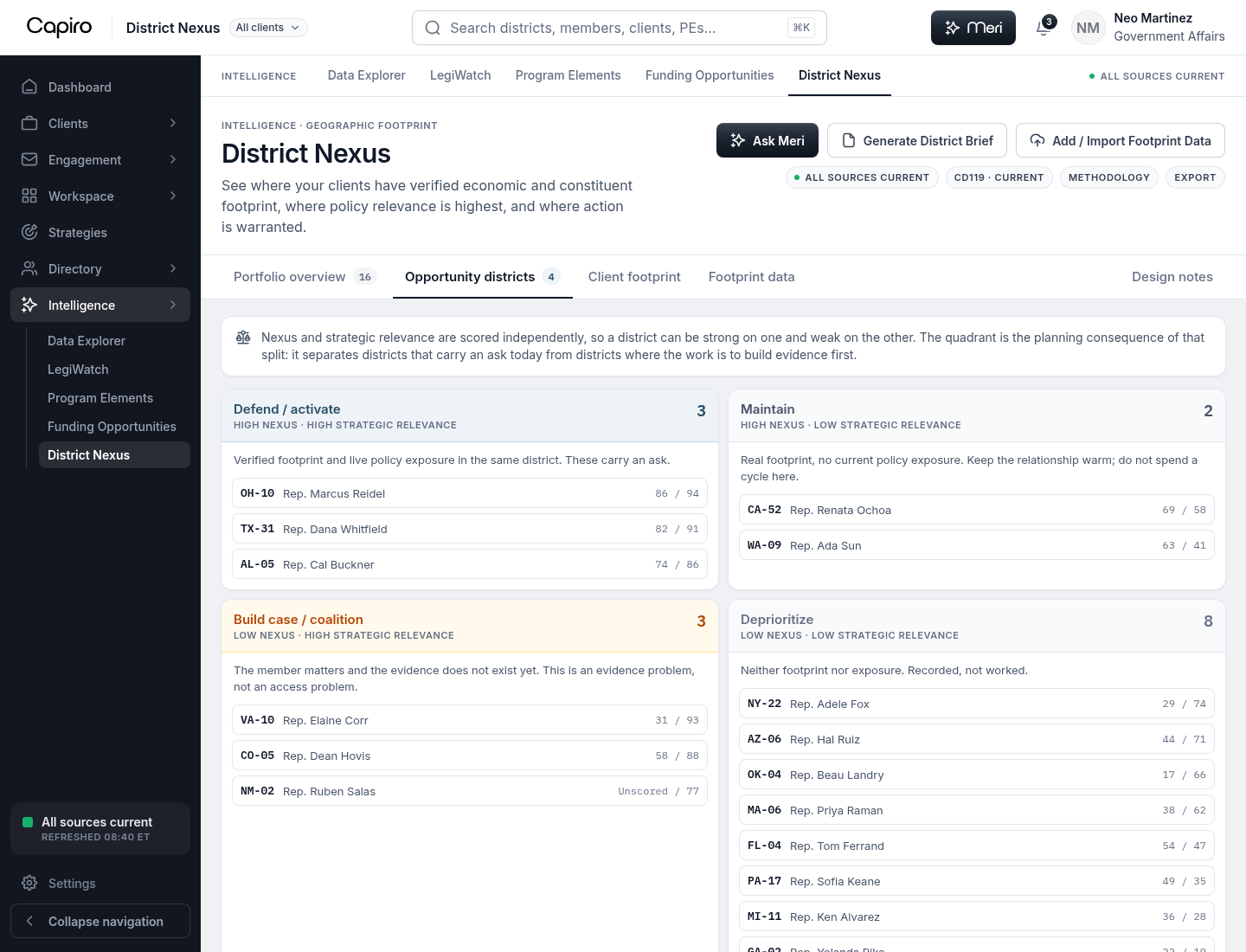
The Opportunity Districts view turns that distinction into a planning tool:
- Defend / activate: strong footprint and strong strategic relevance. There is a case and a reason to make it.
- Maintain: real footprint, limited current policy exposure. Keep the relationship warm.
- Build case / coalition: the policymaker matters, but the local evidence is weak. Build the nexus before making the ask.
- Deprioritize: neither the footprint nor the strategic exposure currently justifies much attention.
Not every office deserves equal time.
District Nexus is allowed to say that out loud.
Open a district and the map becomes a story
This is where the feature gets interesting.
Open a district and the user is no longer looking at a pin.
The district becomes a connected intelligence package.
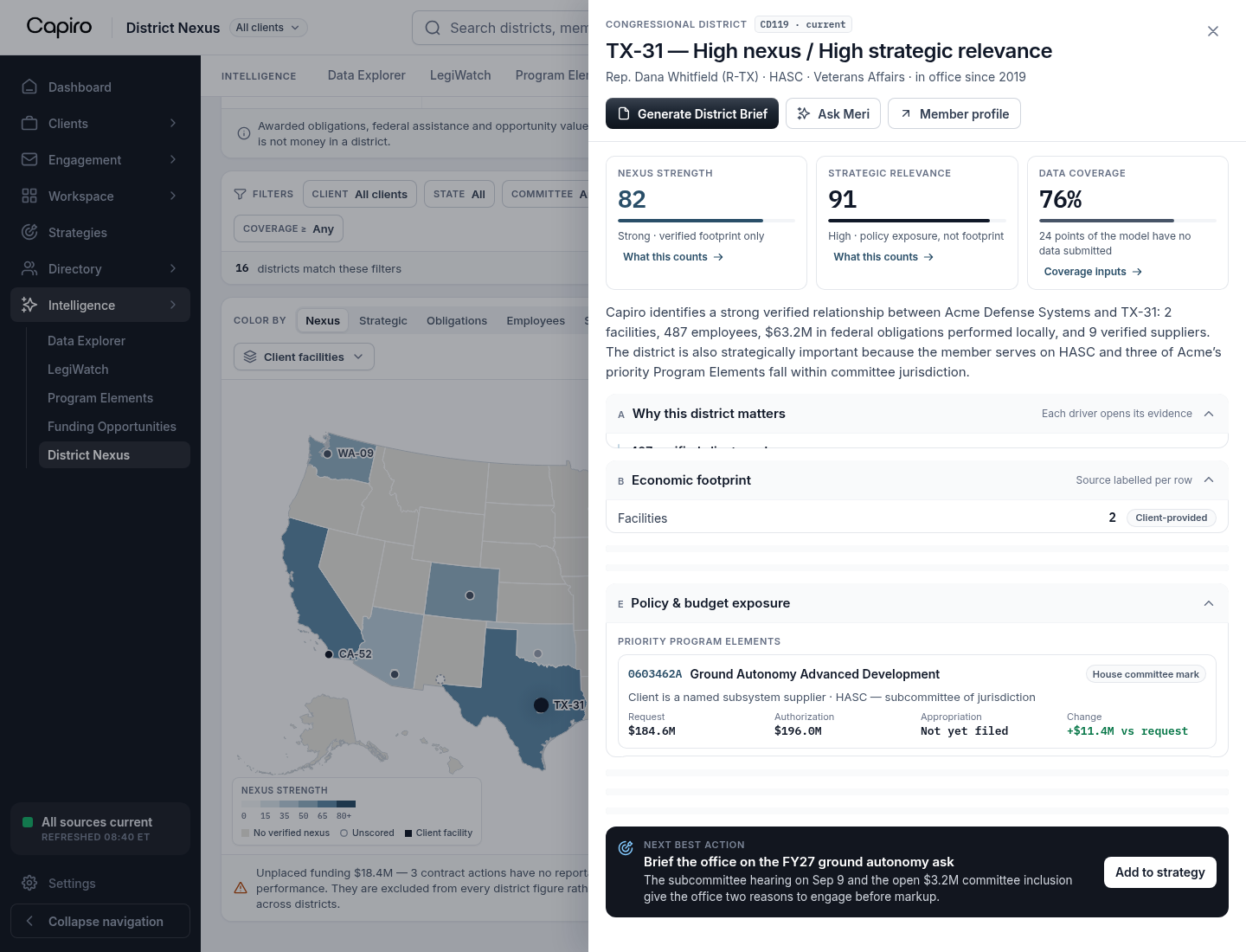
In the illustrative TX-31 preview below, Capiro brings together facilities, employees, federal obligations and suppliers on one side, and committee jurisdiction plus priority Program Elements on the other.
The system keeps those concepts separate, explains why each matters, and then surfaces a recommended next action.
The deeper district experience is designed to connect economic footprint—facilities, jobs, payroll, capital investment, suppliers and federal awards—with the government footprint surrounding it.
Then it adds policy and budget exposure: Program Elements, appropriations activity, legislation, hearings and funding opportunities.
Then representation and relationship context: the member, committees, staff and engagement history.
Then the district facts that actually strengthen an advocacy argument.
The point is not to put more data on the screen.
The point is to make the relationship between the data obvious.
Every number should be able to defend itself
Government affairs teams do not need another black-box score.
If a number is important enough to shape a strategy, it should be possible to answer a very simple follow-up:
“Where did that come from?”
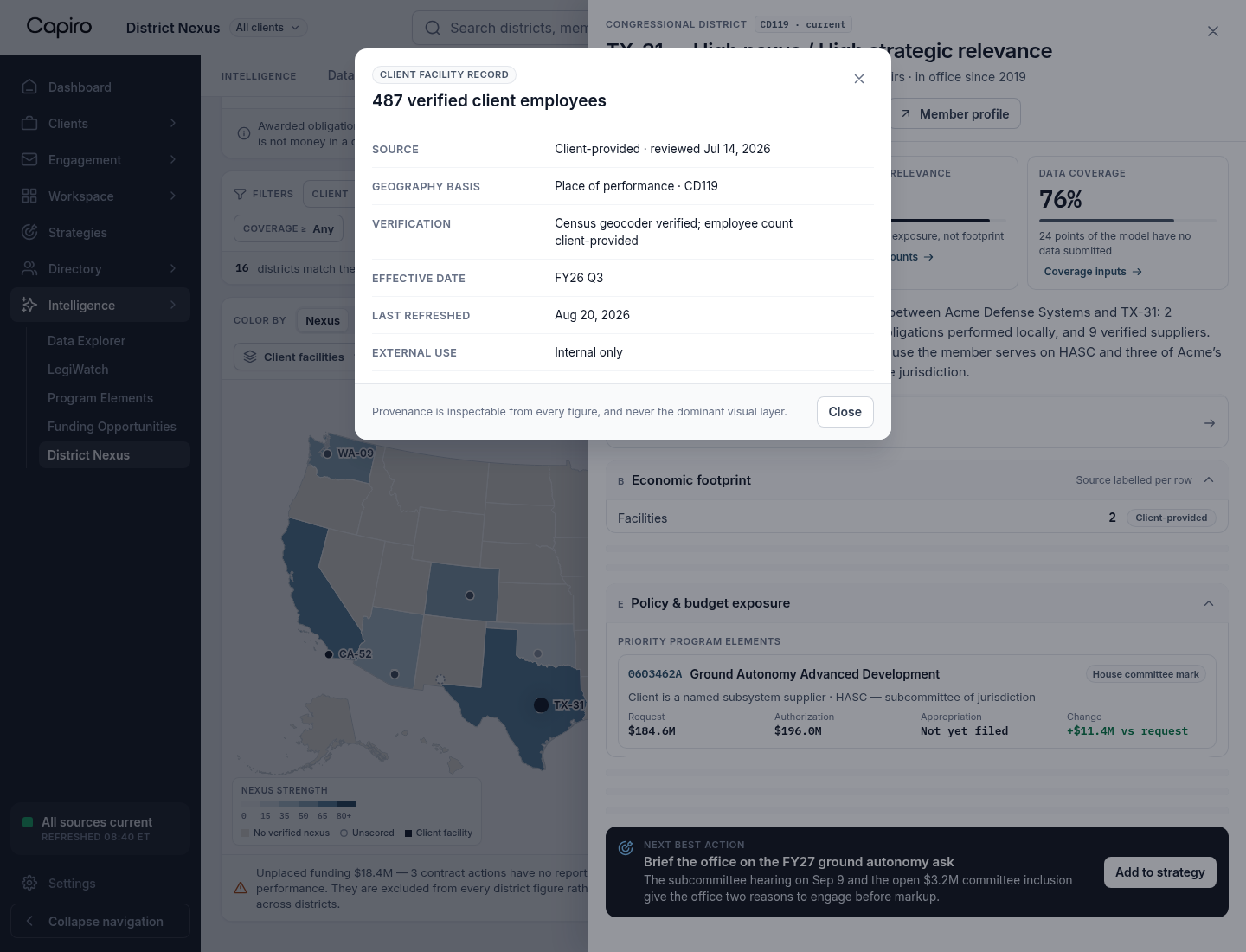
District Nexus is built around evidence, provenance, verification, confidence and freshness.
The product preview takes that principle down to the individual driver: click the figure and inspect the source, geography basis, verification status, effective date and refresh information.
That may sound less exciting than AI.
It is also what makes the AI useful.
A missing value stays missing. Verified and inferred evidence are treated differently. An opportunity is not an award. Committee membership does not magically become economic footprint.
Boring? Maybe.
Important when someone forwards the brief to a client CEO or congressional chief of staff?
Very.
Geography should connect to the policy and budget fight
A client’s facility is only one side of the story.
If the member representing that facility sits on a relevant committee, a priority Program Element is moving through the budget process, a hearing is approaching, or a funding opportunity intersects with the district, those facts should not live in four unrelated modules that the user has to mentally stitch together.
District Nexus is designed to make geography the connective tissue.
That means the same district view can explain not only what is there, but what is happening around it.
The preview also preserves important funding distinctions. A Community Project Funding or Congressionally Directed Spending request can move from requested → included by committee → enacted → awarded without collapsing those stages into one misleading figure.
Because “requested” and “received” are two very different sentences.
Meri already knows where you are
Then there is Meri.
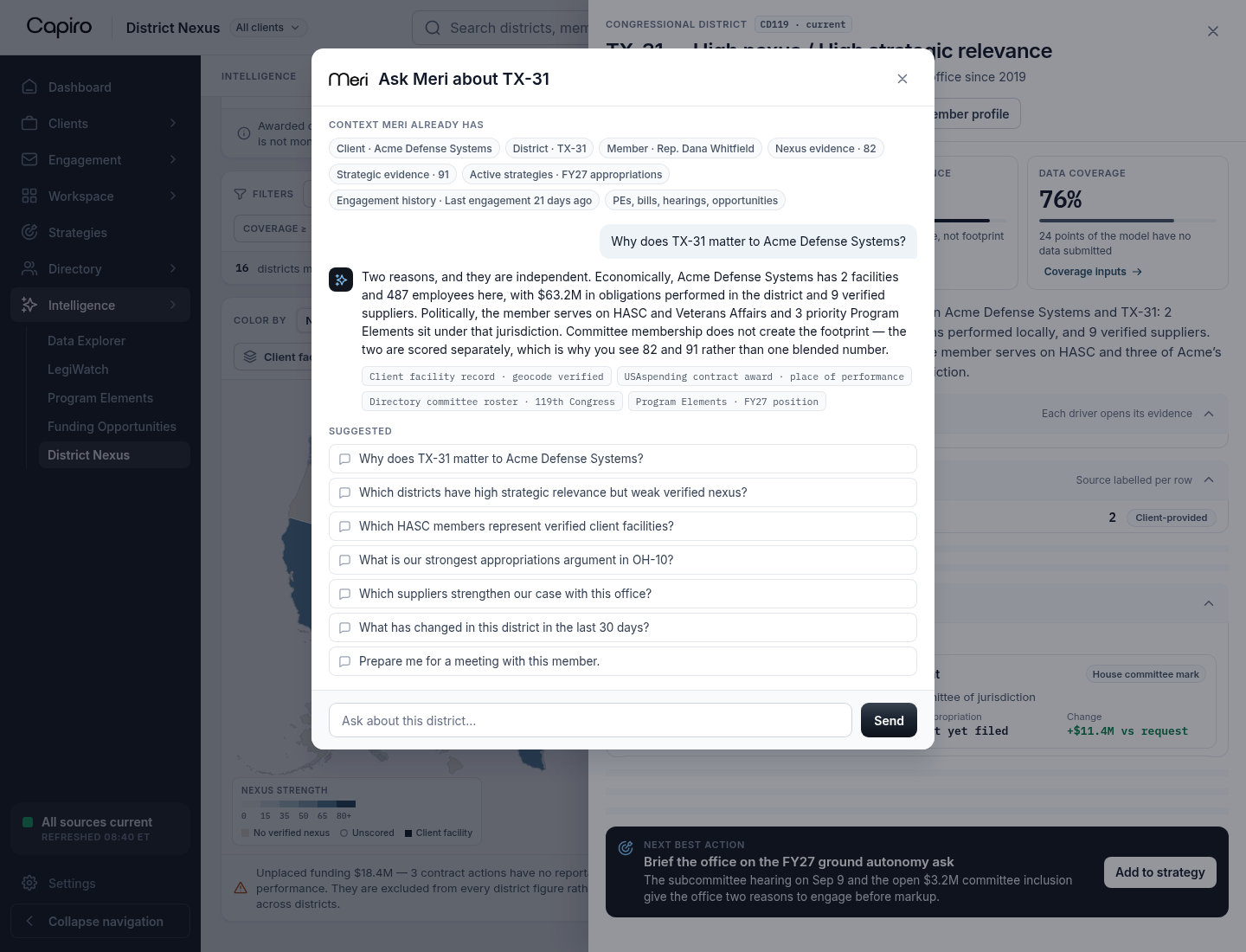
Ask Meri from inside a district and the goal is for the context to come with you: client, district, member, nexus evidence, strategic evidence, active strategies, engagement history, Program Elements, bills, hearings and opportunities.
No copying the district number into a blank chat window.
No re-explaining the client.
No 900-word prompt just to get the AI caught up to the meeting you are already preparing for.
Now the questions start sounding much more like the actual work:
Why does this district matter to my client?
Which districts have high strategic relevance but weak verified nexus?
Which HASC members represent verified client facilities?
What is our strongest appropriations argument with this office?
Which suppliers strengthen the case?
What changed here in the last 30 days?
That is much closer to an AI Chief of Staff than a chatbot with a nicer prompt box.
Turn the intelligence into the thing you actually need
Research is rarely the final deliverable.
Usually, someone needs a brief.
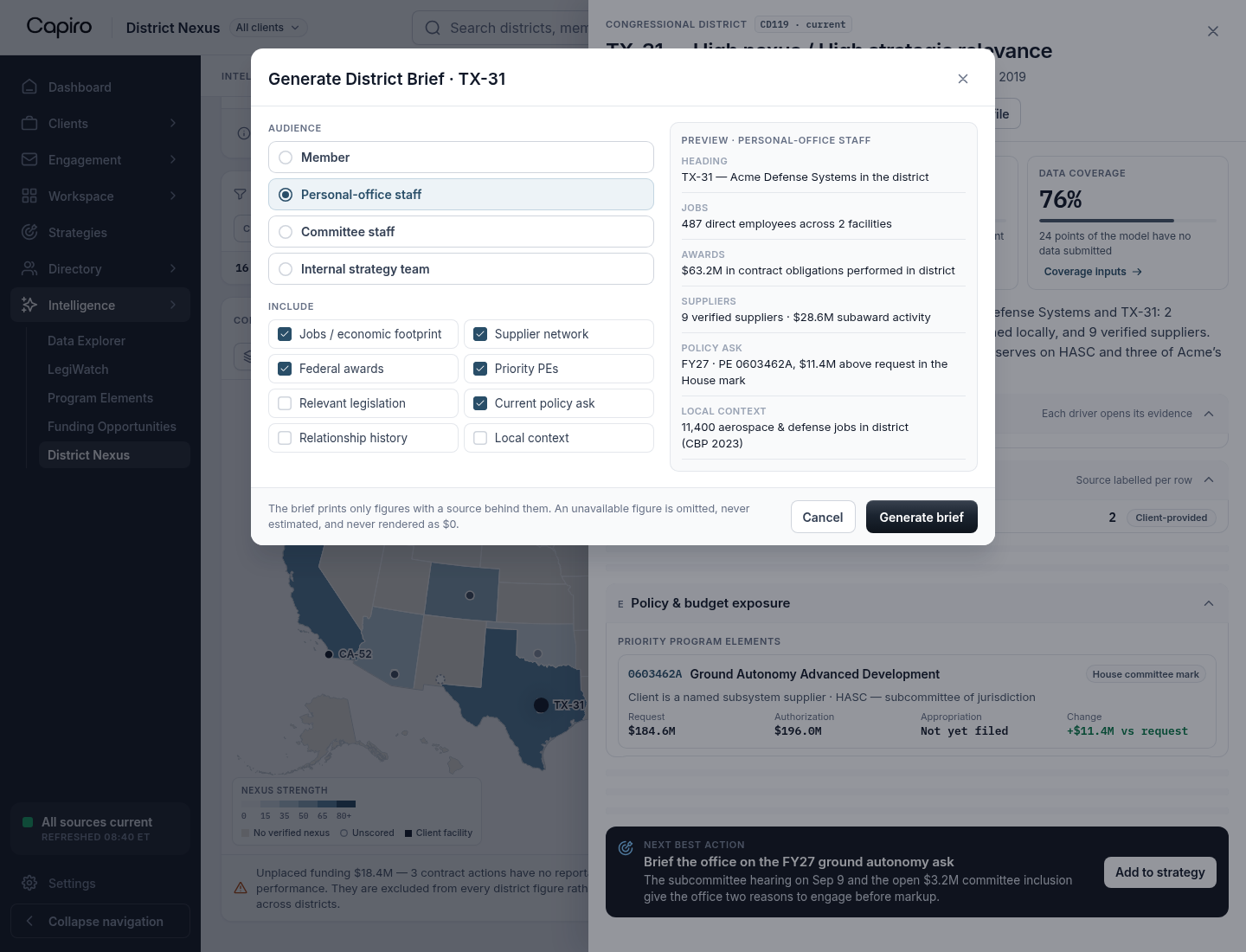
District Nexus is designed to turn the evidence package into a source-backed district brief for a member, personal-office staff, committee staff or an internal strategy team.
The user chooses the audience and sections. Capiro carries the district context forward and omits unavailable values rather than making them up.
Because the last thing your team needs is another beautiful dashboard that ends with:
“Great. Now go make the memo yourself.”
Bring your own footprint—and keep control of it
Public data can tell you a lot.
It cannot tell you everything.
Some of the most persuasive nexus data belongs to the client: employee counts, payroll, capital investment, suppliers, supplier spend, project sites, beneficiaries, local partners and other first-party facts.
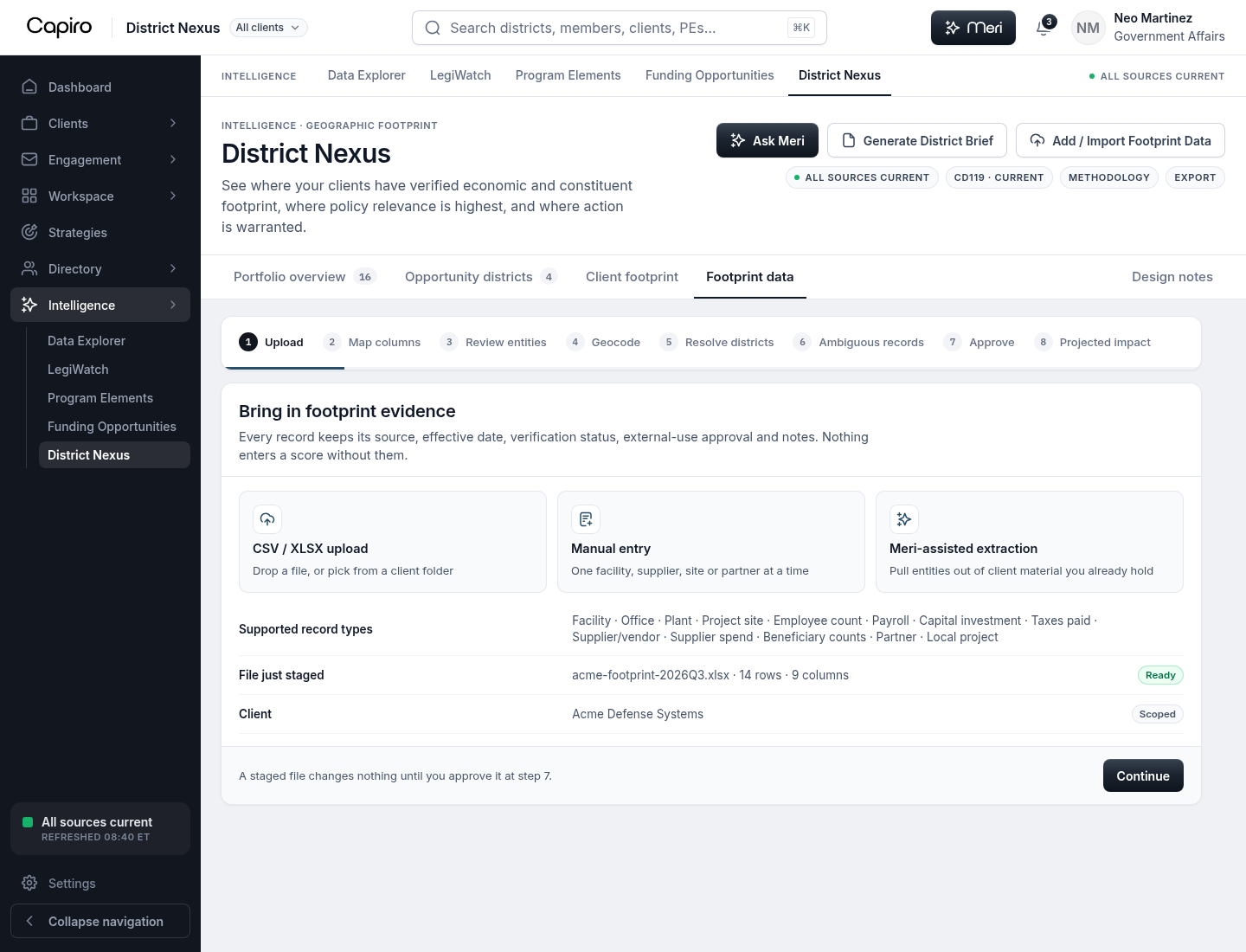
The District Nexus preview includes a structured footprint workflow for exactly that reason.
Teams can bring in data through a spreadsheet, manual entry or Meri-assisted extraction.
Every record can carry its source, effective date, verification status, external-use approval and notes.
And staging a file does not immediately rewrite the client’s footprint.
Before the data is saved, the workflow can show the projected impact on Nexus Strength and Data Coverage so the user sees exactly what is about to change.
That is a small detail with a big consequence:
Users stay in control of the evidence that drives the strategy.
From a map to a geographic intelligence layer
District Nexus becomes especially powerful because it does not have to operate as a standalone product.
Capiro already sits across the other side of the workflow: client capabilities, Program Elements, federal awards, funding opportunities, legislation, hearings, the Directory, engagements, strategies and institutional knowledge.
Connect those systems and the graph starts to look like this:
Client → Capability → Program → Funding → Award → Facility → District → Member → Committee → Staff → Engagement → Strategy
District Nexus is the geographic interface to that graph.
And that is ultimately the point.
Most mapping tools can tell you where something is.
District Nexus is being built to tell you why it matters, how strong the evidence is, what is changing, and what your team should do next.
Because a dot on a map is useful.
A source-backed argument, tied to the right policymaker, the right program, the right relationship and the next action?
That is a strategy.
District Nexus is part of Capiro 2.0.