

Infrastructure for Modern Advocacy
The best advocacy work is invisible when it works, which makes it hard to prove and easy to lose. The firms pulling ahead are turning it into infrastructure that compounds.
Ask anyone who has run a government affairs practice what actually fills the year, and it is not the wins. It is the monitoring. The bill that had to be watched for six months and then died on its own. The amendment that never made it in because someone was paying attention. The relationship kept warm through three cycles before it mattered once. The quiet, constant work of keeping a client out of trouble, which is invisible precisely when it is working.
That invisibility is the central tension of the business. The value is real and mostly unseen, and once a year it has to be defended at renewal against a client who remembers the one win and not the ninety weeks of work that made the win possible. The firms pulling ahead have stopped trying to argue that value from memory. They have started treating the work itself as infrastructure, captured as it happens and compounding as it accumulates. That shift is what this is about.
The Work That Never Makes the Report
Most of what a firm does for a client is defensive and continuous, which means most of it is invisible. The problem is not the work. The problem is that the record of it lives in inboxes, in one person’s head, in a call that never got written down. So when the value has to be shown, it gets reconstructed from scratch, in a hurry, once a quarter.
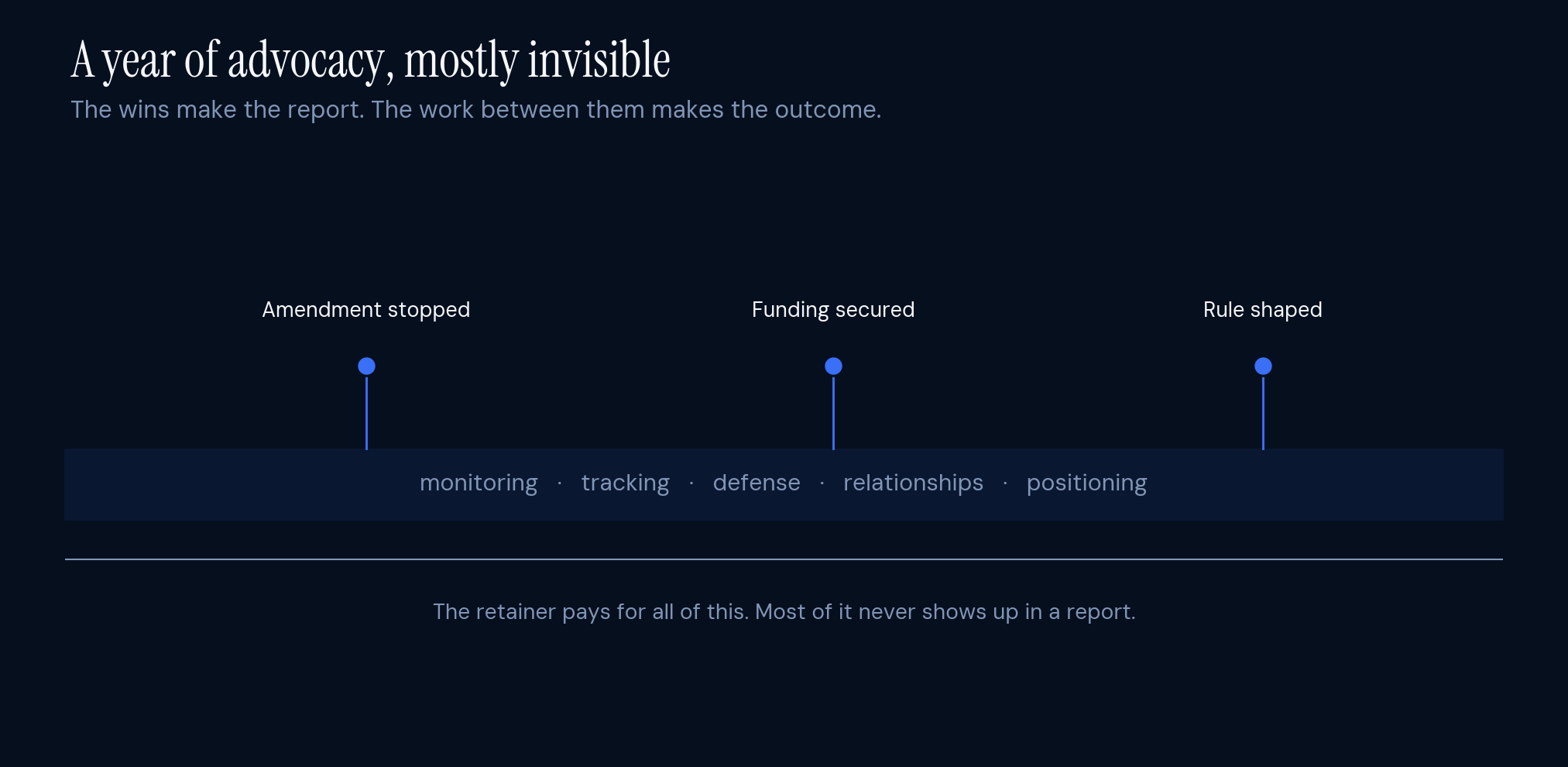
Turn that around and the retainer stops being something you argue for. Every action taken for a client compounds into a visible record, so the case for the engagement is always sitting there in real time, not assembled the week before renewal. The updates clients expect assemble themselves out of work already done, which turns hours of reporting overhead into a byproduct. The math of the engagement shows itself continuously, instead of waiting to be defended. That is the difference between a firm that spends the back half of every month writing about its work and a firm whose work writes its own record as it goes.
Nothing Lives in an Inbox Anymore
The other half of the job is timing, and timing is unforgiving. A markup gets scheduled with little notice. A committee shifts a hearing. A deadline for a funding request lands in the same week three clients all need something else. Miss the window and it costs real money, and the window does not care that the calendar was spread across email, a spreadsheet, and memory.
Infrastructure closes that gap by making the calendar a single, living thing. Every bill, hearing, and deadline across every client sits in one place, tracked automatically, so nothing depends on a person remembering to check. And when committee action moves, it surfaces the moment it moves, so the firm reads the shift as it happens instead of hearing about it afterward. Being early stops being luck. It becomes a system that does not blink.
The Firm’s Memory, Built to Compound
Here is the part that separates a practice that grows from one that simply persists. Every cycle, a firm learns things. Which argument moved a particular office. How a specific approval path actually worked. What a client’s real priorities turned out to be under pressure. In most firms that knowledge stays loose, tied to whoever happened to be in the room, and every new cycle starts closer to zero than it should.
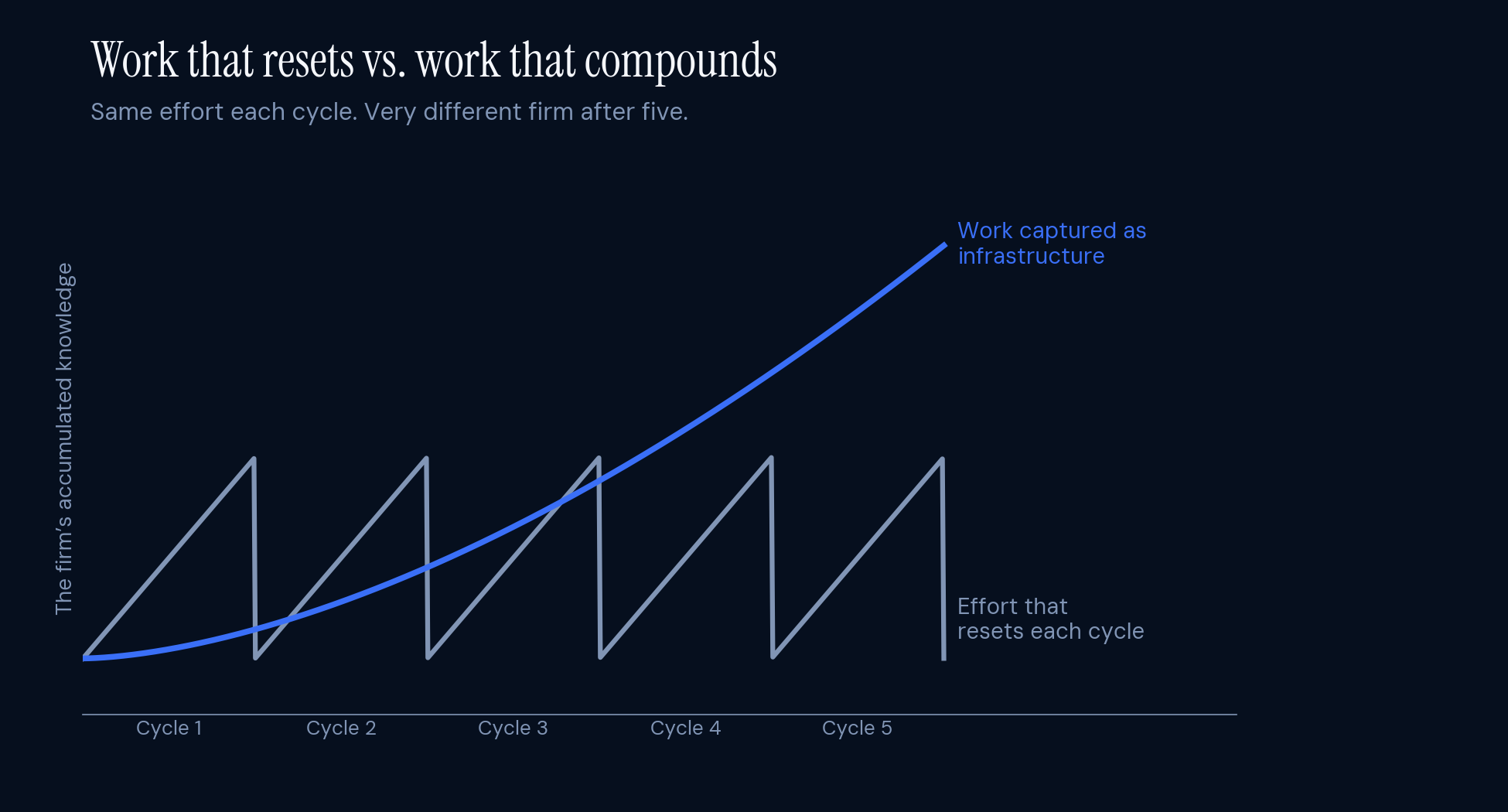
Infrastructure captures that knowledge as it is built. Strategy, relationships, and playbooks become part of the firm’s permanent record, connected to the offices, issues, and clients they belong to, so the practice gets sharper cycle over cycle instead of relearning the same lessons. The work a team does this year becomes an asset the firm still owns in three. That is what turns effort into equity.
A Fuller Book Without a Bigger Team
All of that compounds into the thing every principal actually wants, which is capacity. Onboarding a new client normally means weeks of mapping their needs, their exposure, and the opportunities that fit before anyone can add real value. When capability mapping and funding-opportunity matching happen from day one, that ramp collapses, and a new engagement starts productive instead of starting cold.
And when the busywork of tracking, reporting, and reconstructing is carried by the system, one person can hold a fuller book without dropping the ball on any of it. Growth stops requiring headcount. The same team goes deeper, on more accounts, at once.
Effort Was Never the Shortage
The craft of advocacy has never been the problem. The people in this work are good at it. What has been missing is a way to keep the work from evaporating, a way to let a year of invisible effort accumulate into something visible, defensible, and compounding instead of resetting every cycle.
That is what Capiro is built to be. Not another tool on the pile, but the layer underneath the work that turns everything a firm already does into infrastructure it owns. The wins will still be the headlines. The infrastructure is what produces more of them, and proves the rest.