
The Secret Sauce: Institutional Memory
AI is not the secret sauce. Institutional memory is. The quiet infrastructure behind every great government affairs team.
Right now, nearly every company is rushing to put an AI assistant on top of something: a CRM, a document library, an inbox, a bill tracker, or a shared drive.
The demos look impressive. Ask a question, get a polished answer. Summarize a bill. Draft a memo. Find a contact.
But for government affairs teams, that approach misses the real opportunity.
Government affairs professionals are not paid simply to retrieve information. They are paid to understand what it means.
Why is the chair holding the markup? Which argument worked with this office last Congress? Who on the team owns the relationship? What was promised in the last meeting? Is this staffer genuinely interested, or politely moving you toward the exit?
That knowledge is not sitting neatly in a PDF. It lives across years of meetings, relationships, notes, emails, strategy discussions, and professional judgment.
Without that context, AI is just a very confident intern on its first day.
At Capiro, we believe the right way to build AI for government affairs starts somewhere else. It starts with institutional memory. That institutional memory is Capiro’s secret sauce.
The Problem Is Not a Lack of Information
Most government affairs firms already have more information than they know what to do with.
There are contact records in the CRM, legislative updates in the bill tracker, meeting notes in Word documents, strategy in email threads, and important context buried somewhere in a colleague’s memory.
The problem is that none of it works together.
Your CRM may know that a meeting happened. It probably does not know why it mattered. Your shared drive may contain the meeting notes. It may not connect those notes to the relevant office, staffer, client, issue, bill, and prior conversation. Your most senior advocate may know exactly which argument will move the office. But unless someone asks the right person at the right time, that insight stays trapped in one person’s head.
This is the institutional memory gap: the distance between everything a firm has learned and what the team can actually recall and use when it matters.
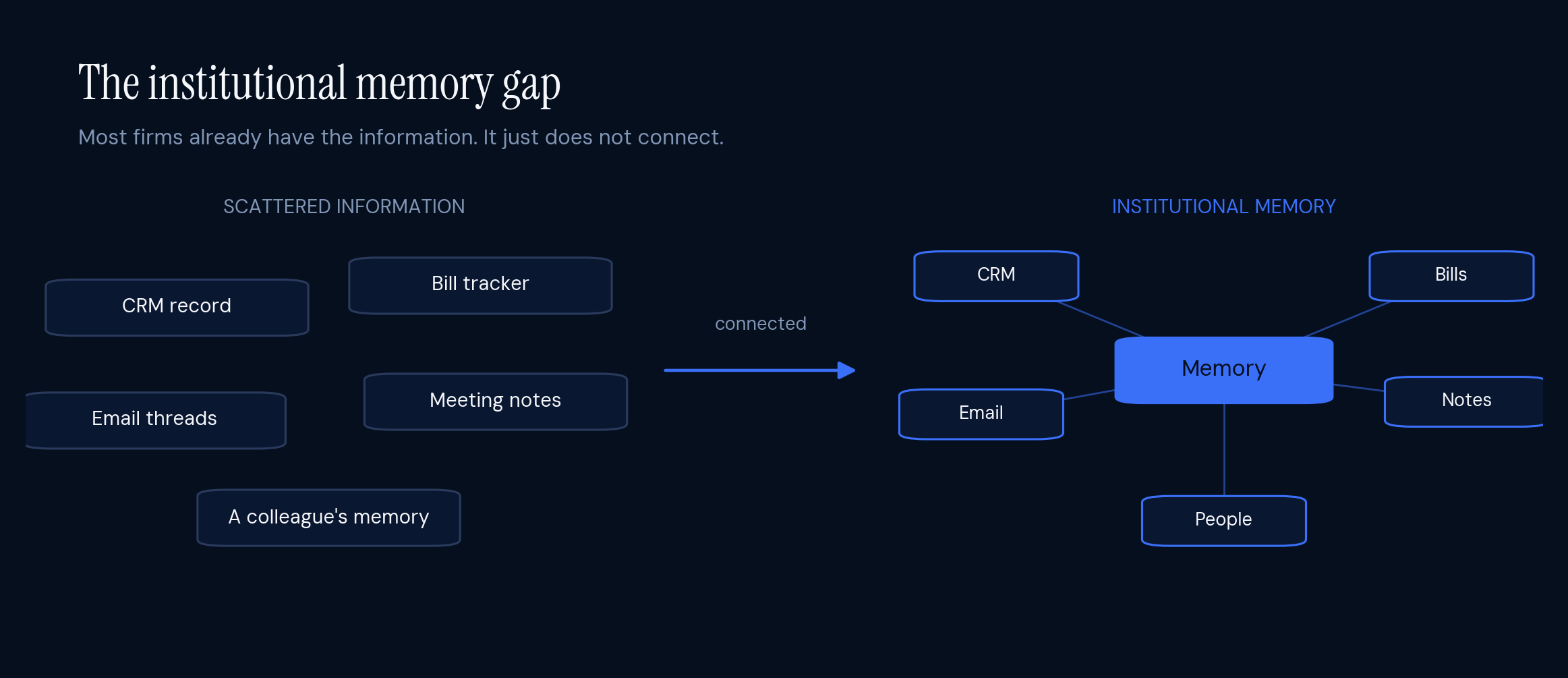
Most firms already have the information. It just does not connect.
That gap has real consequences. Teams repeat asks. Commitments get missed. New hires take months to understand relationships. Senior professionals spend time reconstructing conversations they already had. Valuable context disappears when someone retires, joins an administration, or moves to another firm.
The firm keeps accumulating experience, but too much of that experience never becomes a firm asset.
Capiro Builds the Memory First
Capiro was designed around a simple idea: before AI can be useful to a government affairs team, it needs to understand the firm’s world. That means more than indexing documents.
Capiro builds an institutional memory that connects the people, offices, clients, issues, legislation, meetings, commitments, and strategic assessments that define the work.
A staffer is not just a contact record. That person works for a member, covers particular issues, has participated in previous meetings, raised specific concerns, and may have a history with members of your team.
A bill is not just a number and a title. It affects particular clients, moves through specific committees, involves known decision-makers, and connects to conversations your firm may have been having for years.
A meeting note is not just a block of text. It is part of a larger relationship.
Capiro preserves those connections. That is what turns scattered information into institutional memory, and institutional memory into an advantage.
The Secret Sauce Is Context
The most valuable thing a government affairs professional knows is rarely a standalone fact. It is context.
The office supports the policy, but not if it is attached to this vehicle. The staffer liked the economic argument, but the member responded more strongly to the local impact. The client believes the issue is settled, but the committee counsel raised a concern that remains unresolved. The meeting went well, but someone still owes the office a follow-up.
This is the knowledge that separates a generic briefing from a useful one.
Capiro captures facts and professional judgment while keeping the distinction between them clear. “The markup was postponed” is a fact. “The chair postponed it because the votes were not there” is an assessment. Both matter. They should be connected, but they should not be confused.
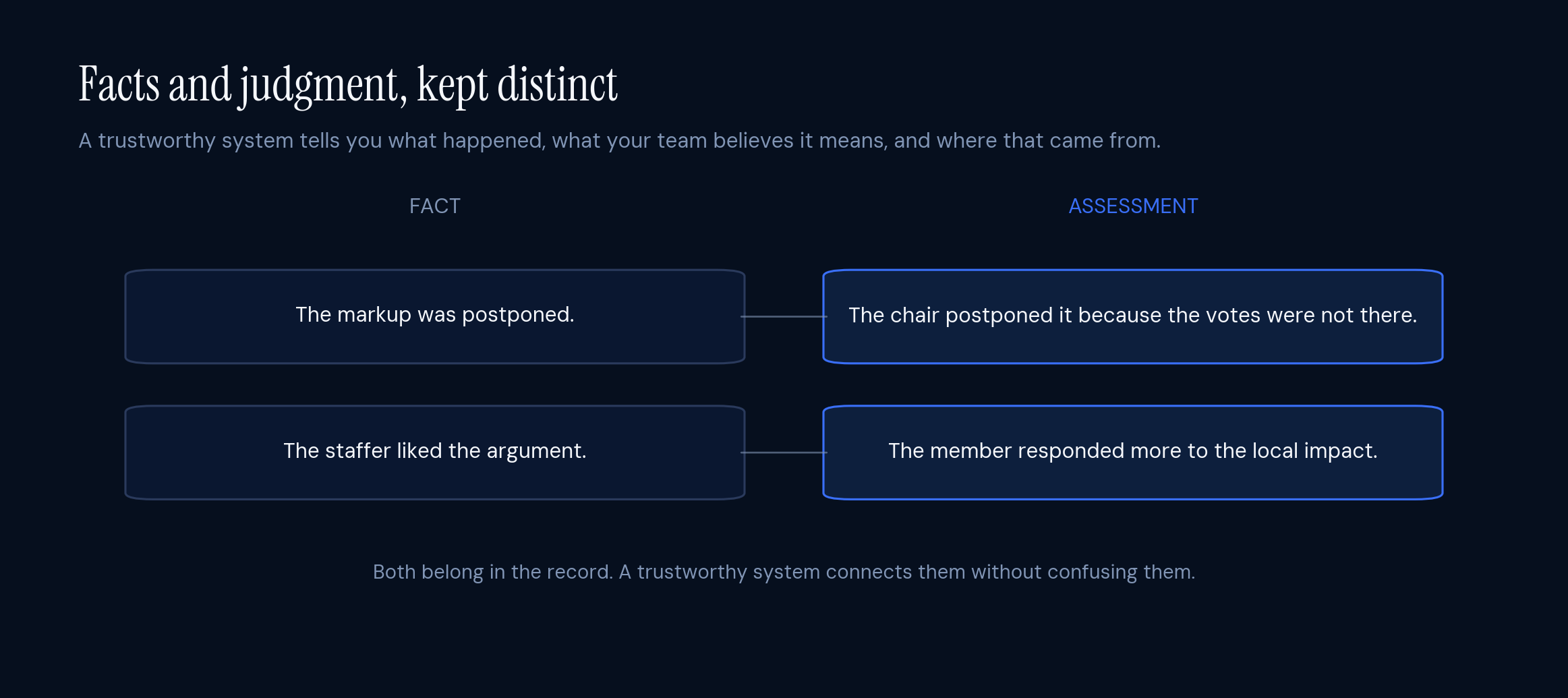
A trustworthy system tells you what happened, what your team believes it means, and where that conclusion came from.
That distinction becomes even more important when AI enters the picture. A trustworthy system should tell you what happened, what your team believes it means, and where that conclusion came from. In government affairs, “sounds right” is not a sourcing standard.
This Is What Makes the AI Valuable
Once the institutional memory exists, AI becomes far more powerful. Instead of asking a general-purpose model to generate a plausible answer, Capiro can ground the response in the firm’s own history and judgment.
A team member can ask:
• What is our history with this office on this issue?
• Which arguments have worked with this committee?
• What commitments came out of our last three meetings?
• Who on our team has the strongest relationship with this staffer?
• What changed in the latest language, and why does it matter to this client?
• What should the principal know before tomorrow morning’s meeting?
The answer should not come from a random internet search or a loose pile of documents. It should come from the firm’s institutional memory.
That is the difference between AI that produces content and AI that helps a government affairs team make better decisions. The model is not the moat. The memory is.
From Meeting Prep to Strategic Advantage
The immediate value is practical. Meeting preparation gets faster and better. An advocate can walk in with the full history of the relationship, not just the last email. Junior staff gain access to context that once took years to absorb. New hires become useful faster because they can understand why relationships and strategies developed the way they did. Senior professionals spend less time answering questions the organization should already know. Teams are less likely to repeat an ask, contradict a colleague, overlook a commitment, or walk into an office without understanding the backstory.
But the larger potential goes beyond retrieval. When Capiro understands the firm’s relationships, issues, priorities, and history, it can begin to recognize patterns.
A change in a committee schedule may look routine to everyone else. Capiro can connect it to a client priority, a previous conversation, and an unresolved concern. A new name on a witness list may be more than a name. It may signal where the debate is moving. A small change in legislative language may echo an issue the team encountered two Congresses ago.
The goal is not simply to help teams find what they already know. It is to help them see what they might otherwise miss. That is where institutional memory moves from archive to advantage.
Built for the Way Government Affairs Actually Works
Government affairs is not a generic enterprise workflow. The information is sensitive. The relationships are nuanced. Facts and judgments must remain distinct. Client boundaries must be strict.
A useful institutional memory cannot become one giant pool of firm information where context from one client quietly appears in another client’s work. Capiro is designed to keep knowledge rich within the appropriate boundary and protected across clients and matters. That is not merely a technical feature. It is fundamental to trust.
The same is true of durability. A firm’s institutional memory should not disappear because a vendor changes direction or a software contract ends. The knowledge must remain understandable, portable, and connected to its sources. The entire point is to create something that outlasts any one employee, Congress, or technology cycle.
Your Firm’s Experience Should Compound
Every meeting teaches the firm something. Every campaign sharpens its judgment. Every relationship produces context that can make the next engagement more effective.
But experience only compounds when the organization can retain it. Otherwise, the firm keeps paying to learn the same lessons over and over again.
Capiro turns that accumulated experience into institutional memory, then makes that memory usable through AI. Not another chatbot. Not another place to store documents. Not a CRM with a shiny prompt box. A system that understands the firm’s relationships, history, and judgment, and puts that knowledge to work.
Most companies are starting with AI and looking for something useful to connect it to. We started with the most valuable thing a government affairs firm already has: everything it has learned.
That is Capiro’s secret sauce. And once a firm has it, working without it will feel a little like walking into a markup without a vote count.