
The Laundry Doesn't Fold Itself
AI handed everyone better intel. The gap now is what you do with it.
The upgrade that became the floor
By 2024, organizations were using generative AI in at least one business function at twice the rate they were a year before.1 Research that used to take hours can now take minutes. Competitive scans that required manual review now surface in seconds. Briefing documents that once demanded significant analyst time can now be drafted in a fraction of it.
The tools got better. Adoption accelerated. And then, according to McKinsey, the same pattern emerged across industries: because so many organizations adopted the same tools and developed similar capabilities, mass adoption did not produce much competitive advantage.2
Worth pausing on that. The technology worked. The productivity gains were real. Workers using AI reported saving an average of 5.4 percent of their work hours.3 And yet across professional services, the competitive landscape shifted less than the pitch decks suggested. If you look at where the first wave of tools was designed to focus, the reason is not hard to find.
What AI optimized, and what it did not
The first wave of AI in professional workflows optimized the intelligence layer. It made it faster and cheaper to know things: what is happening, what the data says, what a document contains, what the competition is doing. Genuinely valuable. Increasingly table stakes.
But in any high-stakes, deadline-driven workflow, intelligence is the input, not the output. Knowing what to do is step one. The work is everything that comes after it.
This is where product thinking matters. In PM terms, intelligence tools solved the discovery problem. Most stopped well short of the delivery problem. A team can have a strong brief with the right targets identified, the competitive pressure mapped, the optimal argument surfaced, and still lose because the execution that follows is slower, less precise, or less consistent than a competitor’s. The brief has to become a draft. The draft has to become a deliverable. The deliverable has to be tailored, routed, tracked, and followed up on. The deadline does not adjust for workload. The audit trail does not build itself.
The first wave of AI was built for the brief. The next wave has to be built for what comes after it.
The gap between knowing and doing
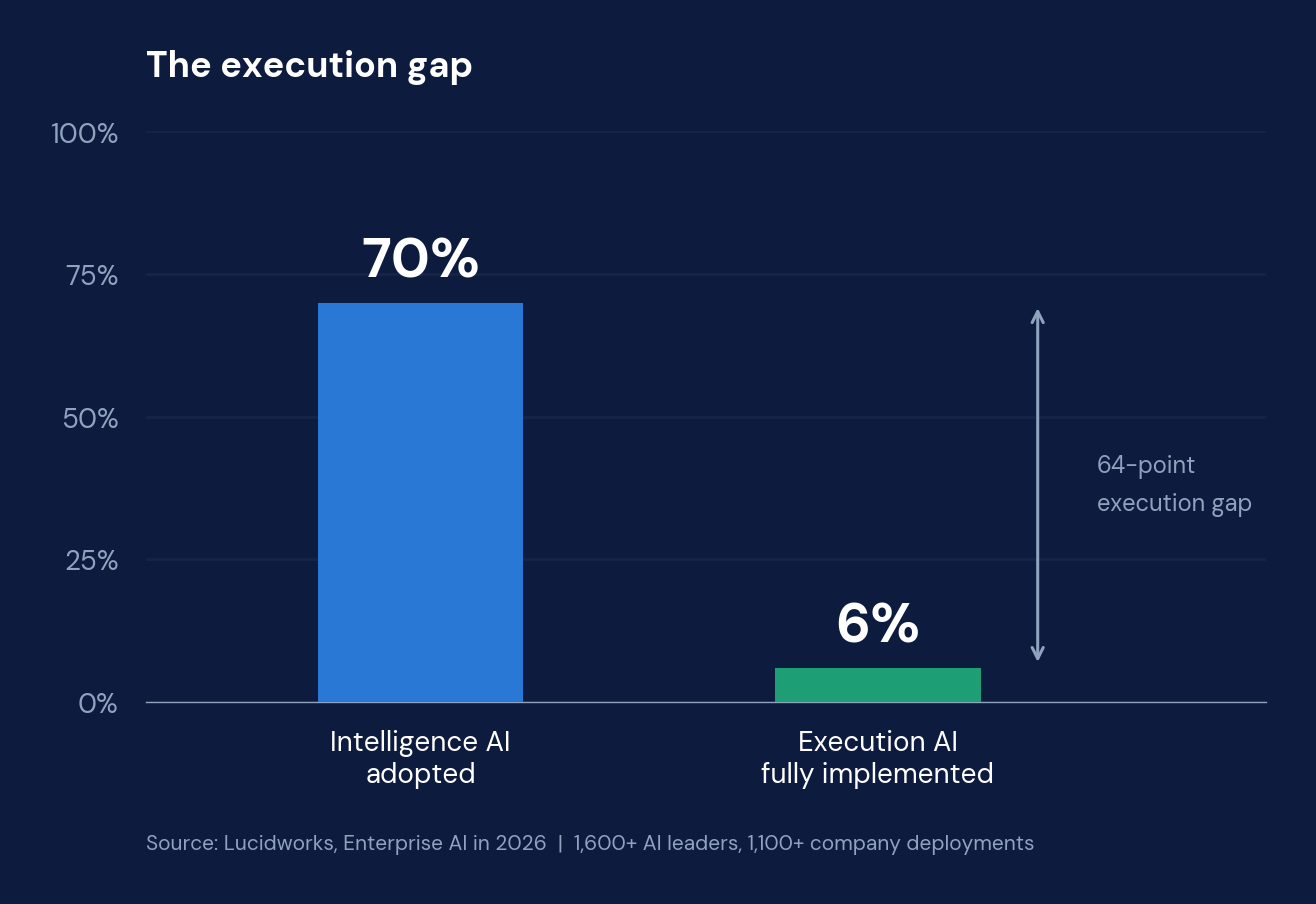
A Lucidworks study of more than 1,100 company AI deployments found that while more than 70 percent of organizations have introduced generative AI into their operations, only 6 percent have fully implemented agentic AI, the layer that actually closes the loop between knowing and doing.4 That 64-point gap is the execution problem in a single number.
Consider what the execution layer actually involves in a complex professional workflow. A deliverable has to be drafted with context specific to this client, this situation, this audience, not a generic version of those things. It has to be customized per recipient when the same underlying ask looks different depending on who is reading it. It has to clear internal review, hit an external deadline, and produce a record that someone can actually use when the next cycle starts.
In most organizations, that execution layer still runs on institutional knowledge held by two or three people, a shared drive that functions more like a filing cabinet, and a calendar of reminders that the team only partially trusts. The intelligence layer got a serious upgrade. The execution layer got a new coat of paint at best.
That gap is where outcomes get decided. Not because teams lacked information, but because the path from knowing to doing is longer and more operationally complex than the intelligence tools were primarily designed to address.
The right AI for the right layer
The obvious product instinct is to point a model at the execution problem. If AI can draft a brief, it can draft the deliverable. If it can summarize the situation, it can handle the submission.
Partially right. Mostly incomplete.
Execution in professional workflows is not a writing problem. It is a context problem. A deliverable that actually works is not a well-formatted document. It is a document grounded in the specific history of this client, this engagement, this counterpart, and what has worked before with this particular audience. A general-purpose model handed a brief and asked to produce that document will often generate something that looks professional but performs like a template. It has no memory of the prior interaction. No record of what arguments landed and what fell flat. No understanding of the institutional context that separates a response from a result.
This is a core product design distinction that gets glossed over in most AI roadmaps: retrieval is not the same as memory. Pulling relevant documents at query time is useful. A system that structurally accumulates context across every engagement, survives personnel changes, and gets more useful the longer it runs is a different architecture entirely. One is a better search. The other is institutional memory that compounds.
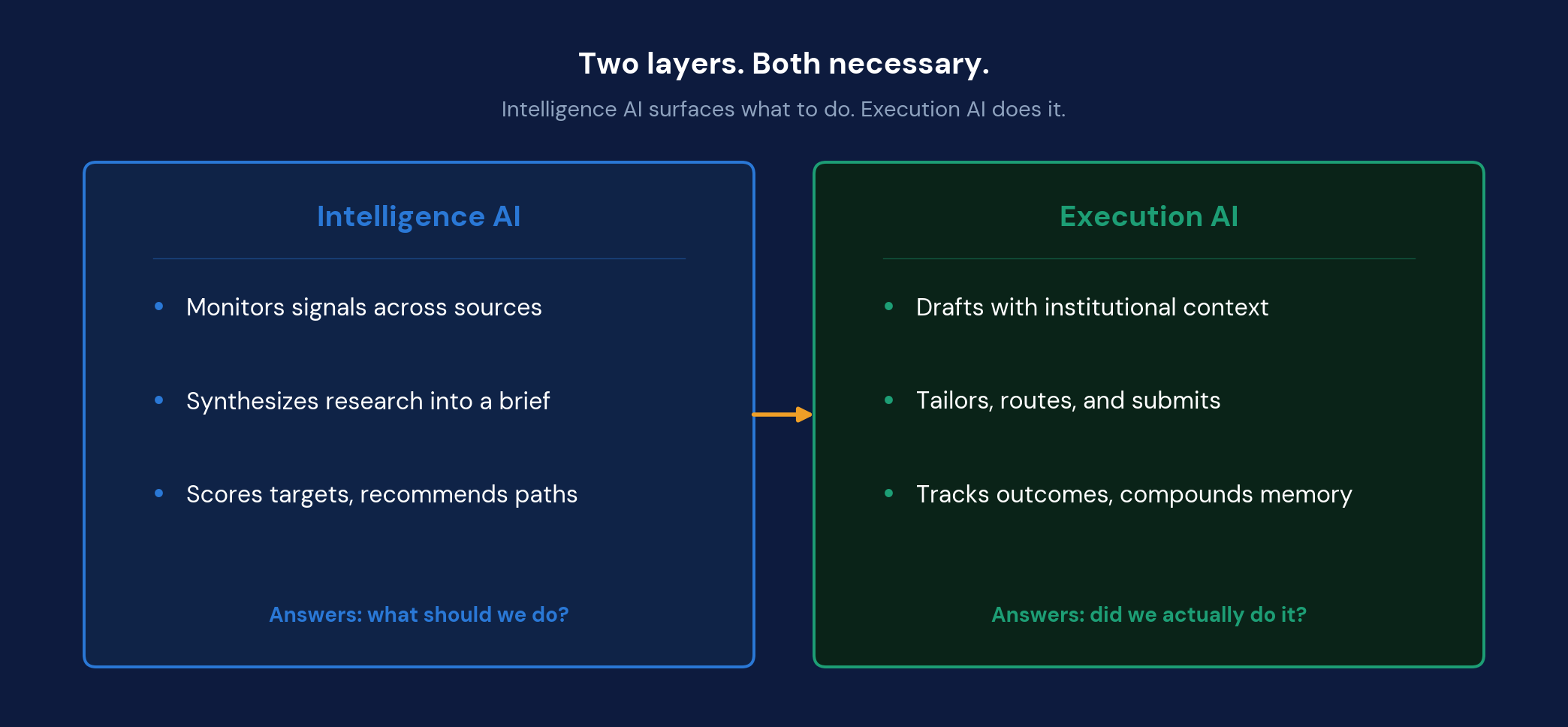
Intelligence AI and execution AI are not the same problem. They are two distinct layers, and they require two distinct approaches. Building for the first is faster. Building for the second is what creates a moat.
What closing the loop actually looks like
The AI products most likely to create durable advantage will not win by producing better summaries alone.
They will win by taking what is known and moving it into what needs to happen next, automatically, in context, with enough retained history to make each action more precise than the last.
The product principle is a closed loop. Intelligence feeds execution. Execution produces outcomes. Outcomes feed back into intelligence so the next cycle starts with more signal than the last. In a well-designed system, each engagement makes it more useful. The team’s accumulated judgment does not walk out the door when a senior person leaves. The context that makes an action effective does not need to be reconstructed from scratch every time.
That loop is the line between a productivity tool and a platform. Productivity tools make individual tasks faster. Platforms compound. They get more valuable the longer a team uses them, because the value is not just in the features. It is in what the system has learned about how the work actually gets done.
The first wave solved for speed of knowing. The product opportunity is in the reliability of doing.
The diagnostic worth running on any AI tool you are evaluating or building: does it get meaningfully better the longer a team uses it, or does day one look the same as day one thousand? If the answer is the same, you have a faster version of what you already had. The moat is in the compounding.
References
1. McKinsey, “The State of AI in Early 2024,” May 2024.
2. McKinsey, “Charting a Path to the Data- and AI-Driven Enterprise of 2030,” September 2024.
3. Federal Reserve Bank of St. Louis, “Generative AI, Productivity and the Future of Work,” October 2025. Citing Bick et al.
4. Lucidworks, “Enterprise AI in 2026,” November 2025. 1,600+ AI leaders, 1,100+ company deployments.