
The Moat Keeps Moving Down
In AI, every capability becomes a buyable feature eventually. Advantage does not vanish, it sinks to the layer no one can buy, and that is the only layer worth building on.
Everyone Will Have What You Have
There is one rule that explains most of what is about to happen in professional AI, and it is not complicated. Anything everyone can buy stops being an advantage. Anything you accumulate stays one.
That rule has a direction, and the direction is the whole point. Advantage does not disappear when a capability spreads. It sinks to the next layer down, the one that cannot be purchased off a shelf. Today’s edge becomes tomorrow’s baseline, and the teams that keep winning are the ones already working a floor below where the crowd is standing. So if you want to know where durable advantage will live two years from now, do not look at the feature everyone is racing to add. Look at what sits underneath it.
The First Layer to Fall
Start with intelligence, because it already fell. Generative AI adoption roughly doubled in a single year, and research from McKinsey found that because so many organizations adopted the same tools at the same time, mass adoption produced little competitive advantage. The technology worked. The productivity gains were real, with workers who used the tools reporting that they saved roughly five percent of their working hours. And yet the competitive landscape barely moved, because an edge that everyone buys at once is not an edge. It is a new baseline. The firms that adopted early did not pull ahead. They simply arrived at the same place a few months sooner, then waited there for everyone else to catch up.
We made a case for this in a recent article: knowing what is happening got fast and cheap, which only raised the floor for everyone standing on it. Intelligence is now table stakes. The useful question is not whether that happened. It is which layer falls next, and what is left standing when it does.
The Wedge With an Expiration Date
Execution is next, and it is closer than the current excitement suggests. A Lucidworks study found that while more than 70 percent of organizations now use generative AI, only 6 percent have deployed the agentic systems that actually close the loop between knowing and doing. That 64-point gap looks like a moat today. It is not. It is a head start.
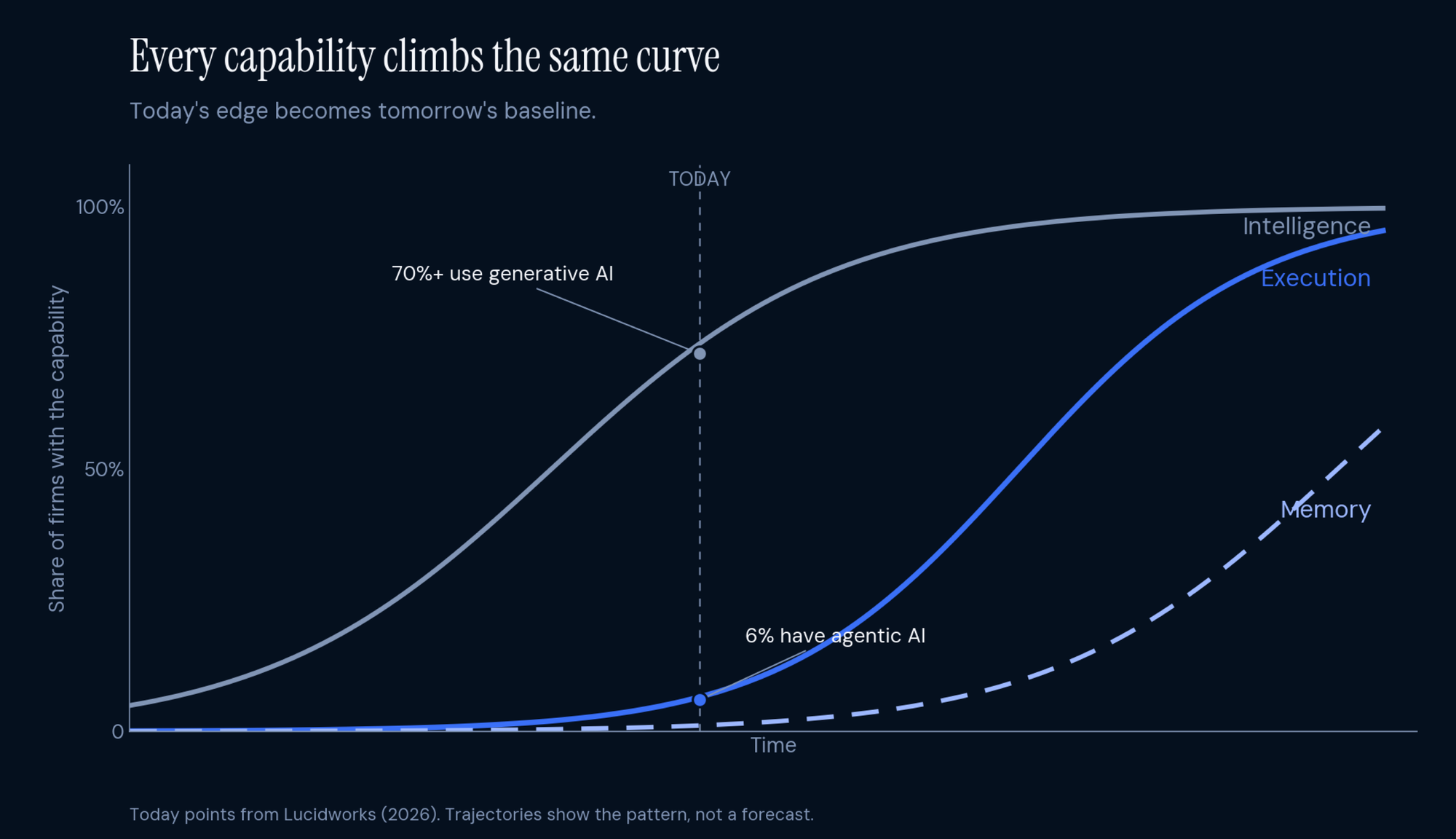
Every capability climbs the same curve, and intelligence sat at six percent once too. The gap between the teams that can execute and the teams that cannot is real, and worth seizing right now, but it closes, the same way the intelligence gap closed, because the agentic plumbing that drafts and routes and submits will become something you buy rather than something you build. Anyone betting the whole company on “we execute and they do not” is betting on a depreciating asset. The window is real. It is still a window, not a wall.
Following the Advantage Down
So follow the advantage down, because below execution sits a layer that does not behave like the ones above it.
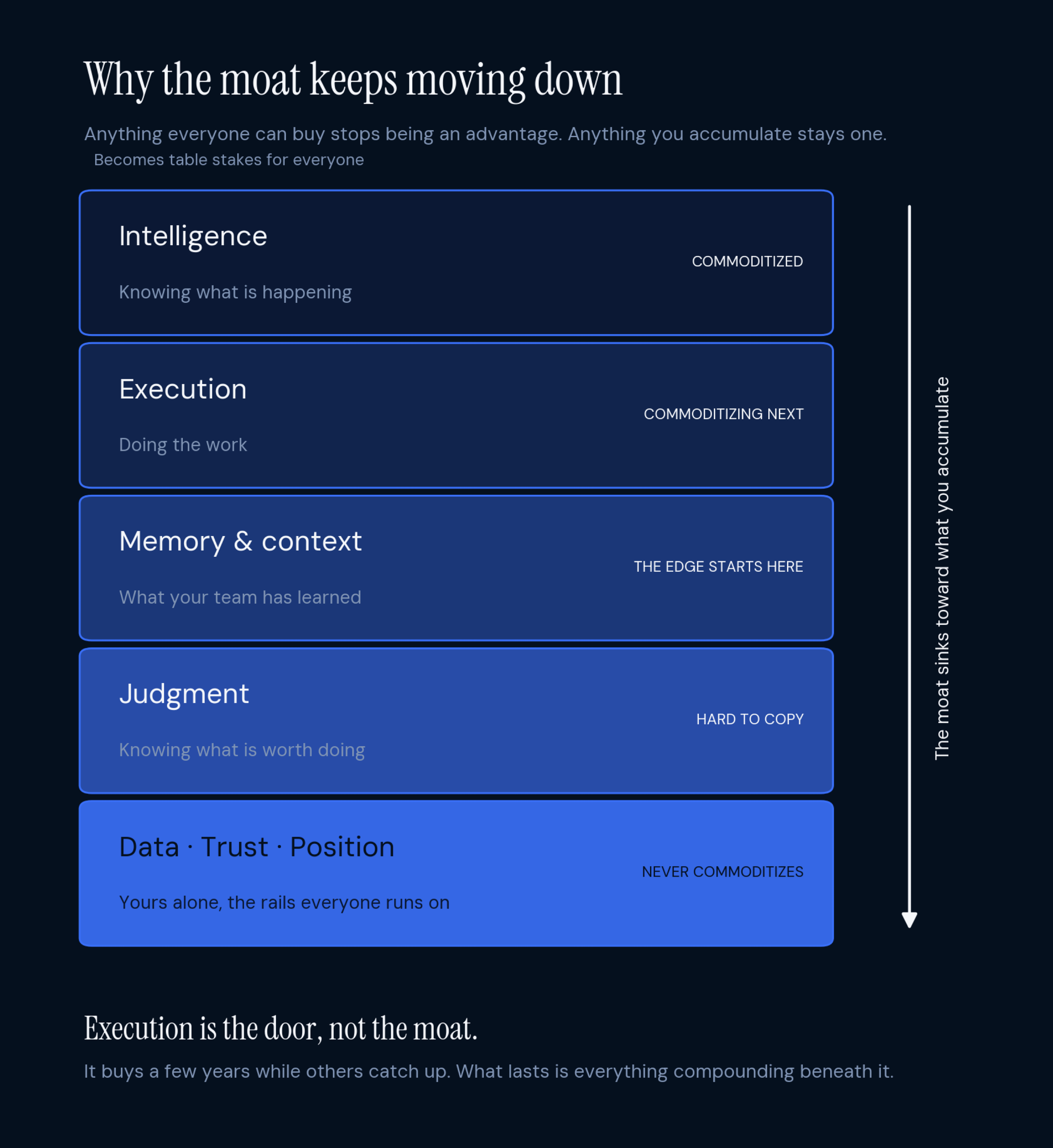
The pattern repeats at every level, with one twist that changes everything. The tool commoditizes. The thing you accumulate with the tool does not. The agentic engine becomes a feature anyone can license. What does not become a feature is execution grounded in context that is specifically yours: the history of this client, this counterpart, what worked last time and what fell flat. A general model handed a brief will produce something that looks right and performs like a template, because it has no memory of any of that. The further down the stack you travel, the less buyable the layer becomes, and the longer the advantage holds.
The layers keep going past execution, and each is harder to copy than the one above it. Memory comes first, the accumulated context of the work. Then judgment, knowing which fights are worth picking and which to walk away from, which is harder to automate than anything sitting above it. And then a floor that does not move at all. It is worth taking memory and the floor in turn, because each is misread in a way that costs companies real money.
Retrieval Is Not Memory
This is the distinction that gets glossed over in almost every AI roadmap, and it is the part that decides who is still standing in five years. Pulling relevant documents at the moment you ask is useful, and it is cheap, and everyone will have it. That is retrieval. A system that structurally accumulates context across every engagement, survives the people who leave, and gets more useful the longer it runs is a different architecture entirely.
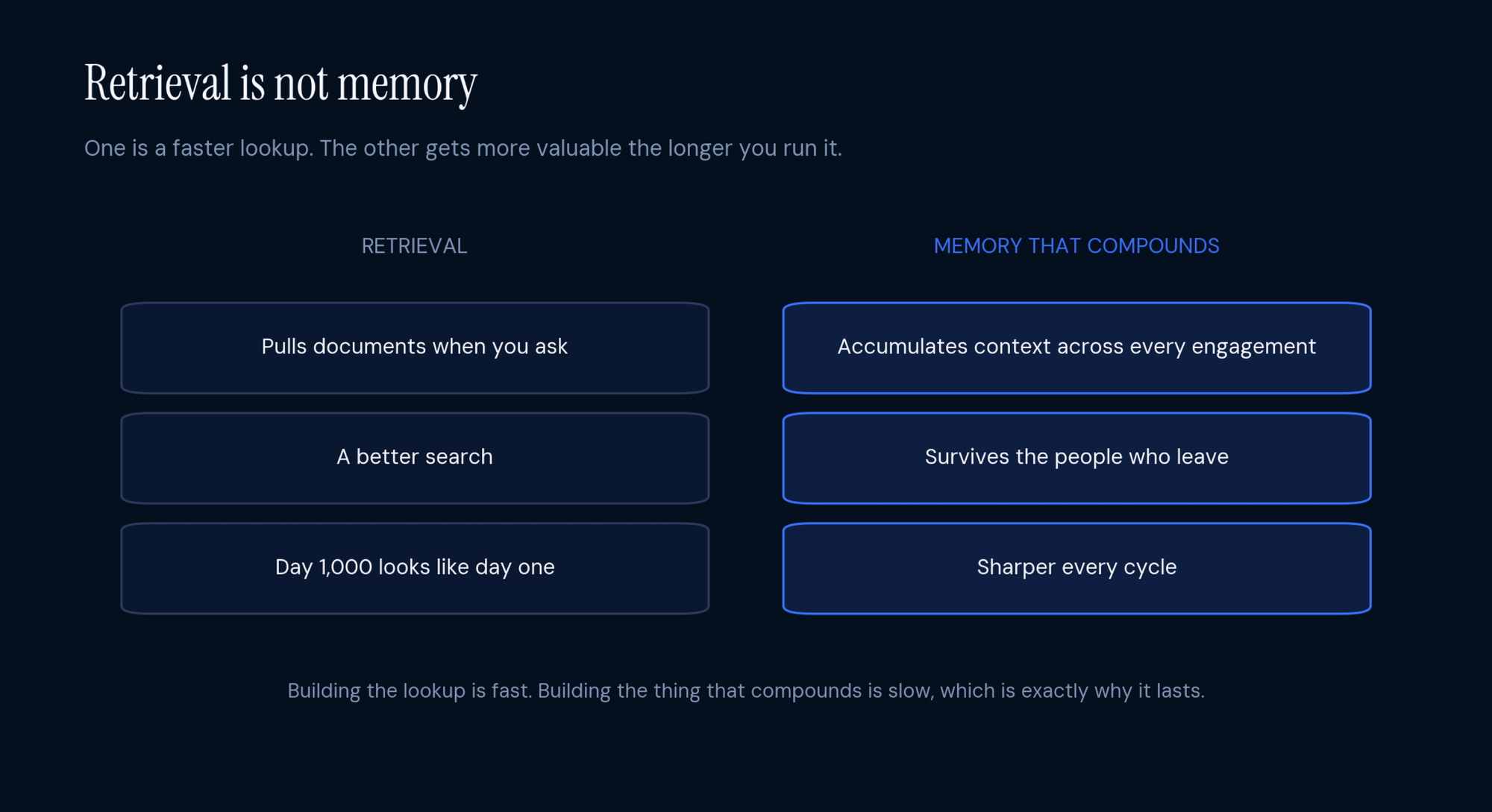
One is a faster lookup. The other compounds. Retrieval looks the same on day one thousand as it did on day one. Memory that compounds does not, because by day one thousand it holds a thousand days of judgment about how the work actually gets done, which arguments landed, which paths were dead ends, which relationships carried weight. Building the lookup is fast. Building the thing that compounds is slow, and the slowness is the point, because anything you can stand up in a quarter, a competitor can stand up in a quarter too.
The Part That Does Not Go on Sale
Keep going and you reach the floor, the layers that were never features to begin with and never go on sale. Your own accumulated data, the kind no competitor can query because it only exists because you did the work. Trust and accountability, which matter most exactly where the stakes are highest, and which cannot be downloaded. And structural position, being the rails the work already runs on, with the switching costs and network effects that come from being the default rather than the alternative. These do not commoditize, because they are not capabilities. They are the residue of having done the work, over time, in a place others have come to depend on.
There is an honest tension here, and it is worth naming because it cuts against the instinct to hoard. The durable version of this does not lock a customer in by trapping their data. The raw data should be portable, because portability is what earns trust, and trust is one of the floor layers you are trying to build. The moat is never the raw data. It is the connected, compounding intelligence built on top of it, the workflow an entire team has organized itself around, and the relationships that do not export. Bet on those, not on being the only one holding the file. A moat made of captivity erodes the moment a better option appears. A moat made of accumulation gets deeper every day you operate.
The Only Question Worth Asking
All of which collapses a noisy buying decision into a single question. When you evaluate any AI tool, or set out to build one, ask whether it gets meaningfully better the longer your team uses it, or whether day one looks like day one thousand.
If the answer is that day one thousand looks like day one, you have bought a faster version of what you already had, and so has everyone else, and the advantage will be gone by the time the contract renews. If it compounds, you are holding the one thing on the entire stack that does not go on sale. The features will keep arriving, and they will keep becoming table stakes the moment they land. The advantage was never going to live in the features. It was always going to live underneath them, in the part that only time and accumulation can build, and that is the only part worth building your company on.