
The Tariff Fight Has a Deadline Now
A Supreme Court ruling took away the executive’s tariff tool and put the whole trade fight on a 150-day congressional clock. The filings show an industry changing venues in real time.
For most of a year, if you wanted relief from a tariff, you worked the executive branch. You asked for an exemption, a carveout, a delay, a product exclusion. The tariffs came from the president, so the president is where the effort went.
That door closed on February 20, 2026. The Supreme Court ruled 6 to 3 in Learning Resources, Inc. v. Trump that the emergency-powers statute the tariffs were built on does not let the president impose them. The pen that had driven a year of trade policy was gone. The fight did not end. It moved, and it moved onto a clock.
The Biggest Trade Year the Filings Have Ever Seen
Before the ruling, the numbers were already at levels the record had never touched. As companies scrambled to soften the tariffs coming out of the White House, trade became the fastest-growing corner of the influence business.
The count of organizations working on tariffs more than tripled in a single year, from 120 in 2024 to 382 in 2025.
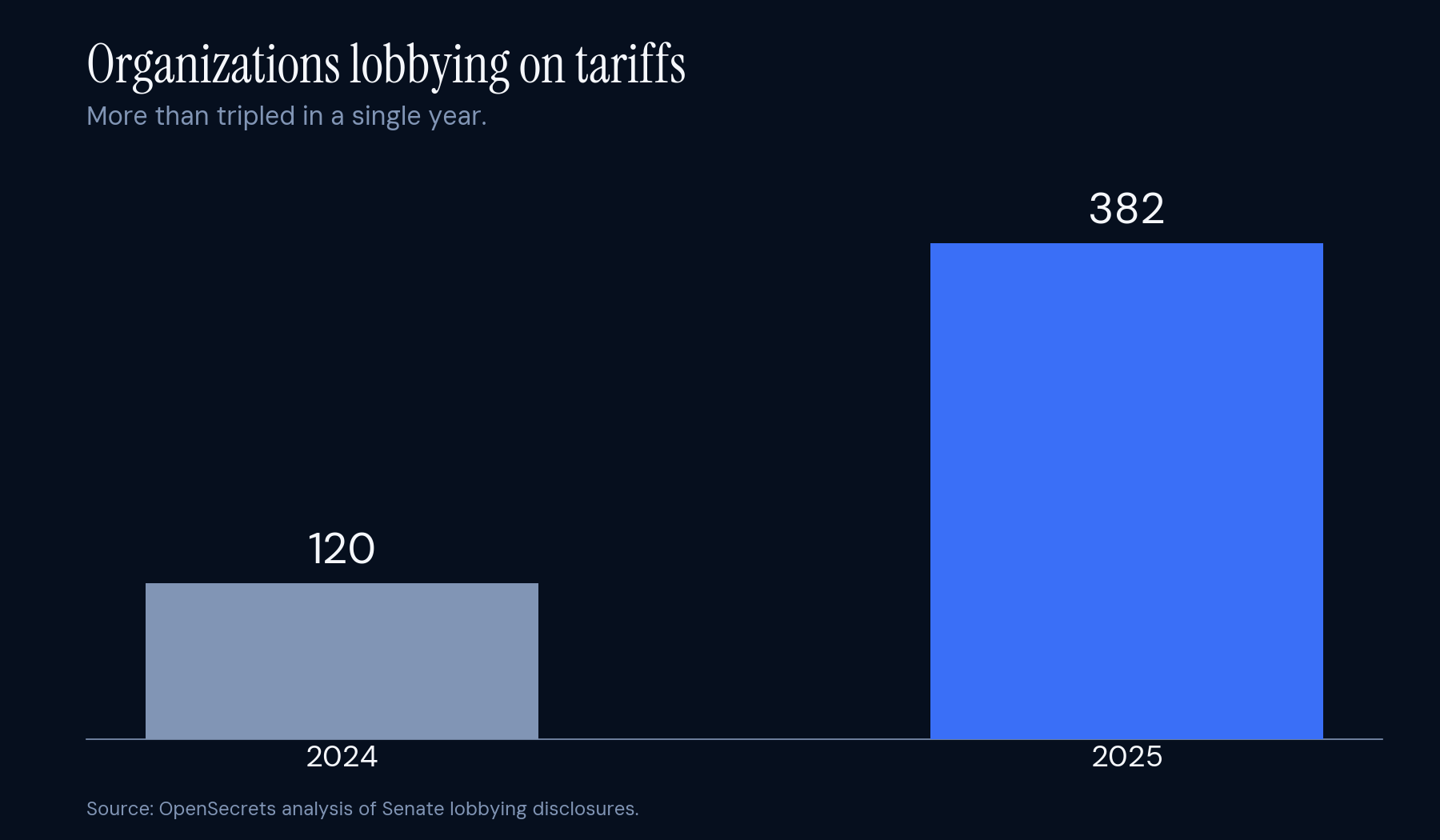
Behind that jump sits a wall of money and motion. Revenue tied to trade advocacy rose to roughly 137 million dollars in 2025, up nearly 80 percent from the year before, and the number of firms reporting trade work climbed toward 1,500. Tariff-specific work went vertical, with revenue on tariff legislation rising nearly sevenfold, from about 2 million dollars to more than 14 million. By one analysis of the disclosure database, more than 800 companies hired new representation on trade or tariffs in 2025, roughly double the previous record set in 2019, with names like Walmart and Whirlpool among them. The third quarter of 2025 alone produced more than 2,300 filings that mention trade or tariffs.
That was the world with the pen still in the president’s hand. Then the pen broke.
The Same Pressure, a New Building
When the Court removed the executive’s authority, the administration reached for the one tool left that could move fast: Section 122 of the Trade Act of 1974, a balance-of-payments surcharge. It took effect on February 24 at 10 percent, then moved toward 15. But Section 122 carries a catch the old authority never had. It lasts 150 days. After that it dies, unless Congress votes to extend it.
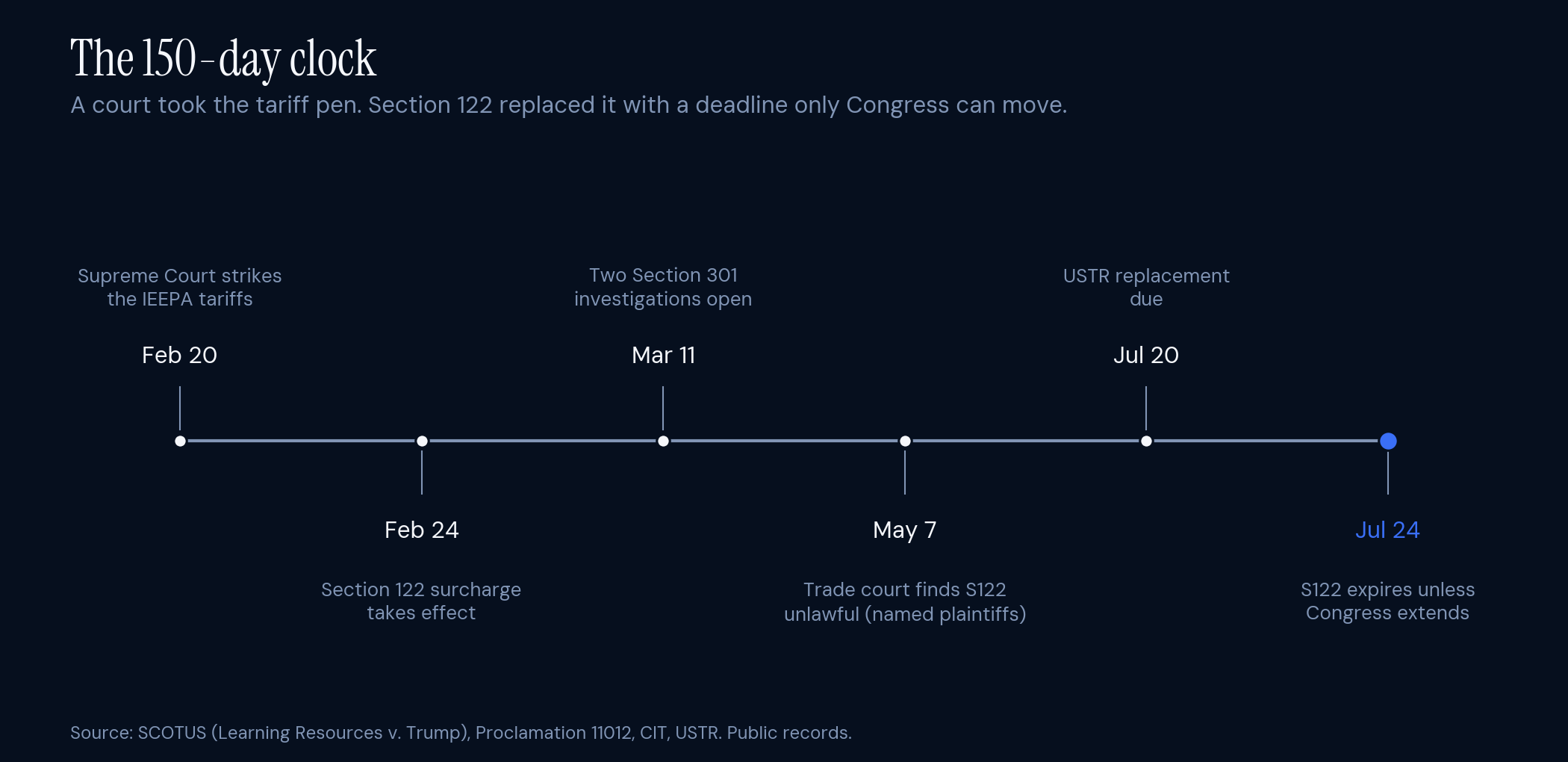
That single provision rewired the game. The trade fight no longer runs through agency exemption requests. It runs through Congress, and it runs against a date: July 24, 2026. Extending the surcharge takes an act of Congress. Ending it early takes an act of Congress. The refund fight over the duties already collected runs through Congress. The Section 301 investigations meant to replace the surcharge report on a timeline that lands days before it expires. And the loudest bill in the room, the Reclaim Trade Powers Act, would move tariff authority further from the president rather than hand it back. As of now, no extension bill has even advanced.
Every one of those is a legislative fight. Which means every company with a stake in a tariff, and there are hundreds of them now, is being pulled off the agency inbox and onto the congressional calendar, on a clock, months before a midterm.
What the Filings Show Before the Headlines Do
This is the part most people miss, because the shift does not announce itself. It shows up first in the disclosure record, one filing at a time, weeks before it becomes a story.
That is what we built Capiro to see. Our database holds 526,581 lobbying filings, updated continuously, with the second-quarter 2026 trade filings posting in real time as registrants report the work they did after the ruling. When a fight changes venue, the record changes with it: new registrations under trade issue codes, longtime clients adding Congress to filings that used to name only agencies, and companies filing on trade for the first time because a deadline made them. Those signals sit in the filings the moment they post.
Seeing them in the moment, connected rather than scattered across a search box, is the difference between reading last quarter’s summary and watching an industry reprice its strategy while it happens. The early quarter of 2026 already carried the shift, with trade filings up 24 percent over the year before and roughly 1,458 clients reporting trade activity in the first quarter alone.
The Question Worth Asking
The old question in trade work was a research errand. Who can find me the right filing, the right exemption path, the right agency contact.
The new question is strategic, and it has a clock on it. Where did the fight move? Who is newly in it? What did Congress actually change this week? Is my client’s exposure tied to the surcharge that sunsets, or to a Section 301 track that outlives it? What is the next move, and how many days are left to make it?
The teams that answer those fastest will not be the ones with the most contacts. They will be the ones who can see the whole board move in the record, in real time, and act before July 24 becomes the next deadline after it.
Sources: OpenSecrets analyses of Senate lobbying disclosures (2025 annual and first-quarter 2026); LegiStorm, tariff and trade lobbying totals for 2025; American Enterprise Institute analysis of the LDA database, January 2026; Supreme Court of the United States, Learning Resources, Inc. v. Trump (February 20, 2026); Proclamation 11012; U.S. Court of International Trade; Office of the U.S. Trade Representative.