

The Work Nobody Counts
Every government-backed win is the end of a chain of work almost nobody sees, and that work, not the money, is where the leverage sits.
Received, Won, Got
Every time a company lands a government loan, a federal contract, or an early check from a public fund, the story gets told the same way. The company received it. It won it. It got it. The language makes government support sound like weather, something that settles on the lucky. It never works that way.
Behind each of those outcomes is a body of work that almost nobody sees, and that work, not the money, is the part worth understanding. The scale is not small. The best available count puts government somewhere in the story of roughly a quarter of America’s billion-dollar startups. What no one has counted is the work it took to get there. This is about that work.
A Quarter of the Outcomes
Start with how much is riding on it. A Commonweal Ventures study of venture-backed American companies that crossed a billion dollars in value between 2003 and 2023 found that government intervention drove about 24 percent of those outcomes. Extrapolated across the full set, that is roughly $1.6 trillion in company value with government somewhere in the story, and the federal government alone, by their estimate, puts on the order of $100 billion a year into it through grants, contracts, tax incentives, and more.
That is a serious finding, and it should retire the lazy version of the all-private-sector creation myth. It also quantifies the outcome and stops there. It counts the companies that got government support. It does not count the work it took to get it. That is the layer worth adding.
The Work Behind the Verbs
Look at the named examples and watch the verbs. Tesla received a $465 million loan from the Energy Department. Palantir received about $2 million from In-Q-Tel. Scale AI won a $250 million agreement with the Defense Department. Received. Won. Got. The phrasing makes it sound like something that happened to these companies. None of it happened to anyone.
Tesla did not receive a loan. Someone identified the Loan Programs Office, understood what it existed to fund, built an application that cleared the technical and financial bar, and carried it through. Palantir did not get In-Q-Tel money. It got rejected by everyone else first, and then someone made the case that landed the only outside investor it could find, the investor who then made the introductions that produced its first intelligence customers. Scale did not win a quarter-billion-dollar agreement out of the air. Someone learned the acquisition process, positioned the company inside it, and followed through for months.
Every entry in that 24 percent is the end of a chain of work the number cannot see. Change the verb and you change what you are looking at. These companies did not receive. They went and got.
The Drive Before the Score
The chain is longest, and most hidden, on the procurement side. Picture a company that wins a government contract. Before it could win anything, the dollars had to be sitting in a program manager’s budget. Before that, an appropriation had to fund the line. Before that, an authorization had to create the program at all. And before any of that, someone made the case, justified it, and moved it through committees and cycles, often a year or more before the contract the company eventually won even existed.
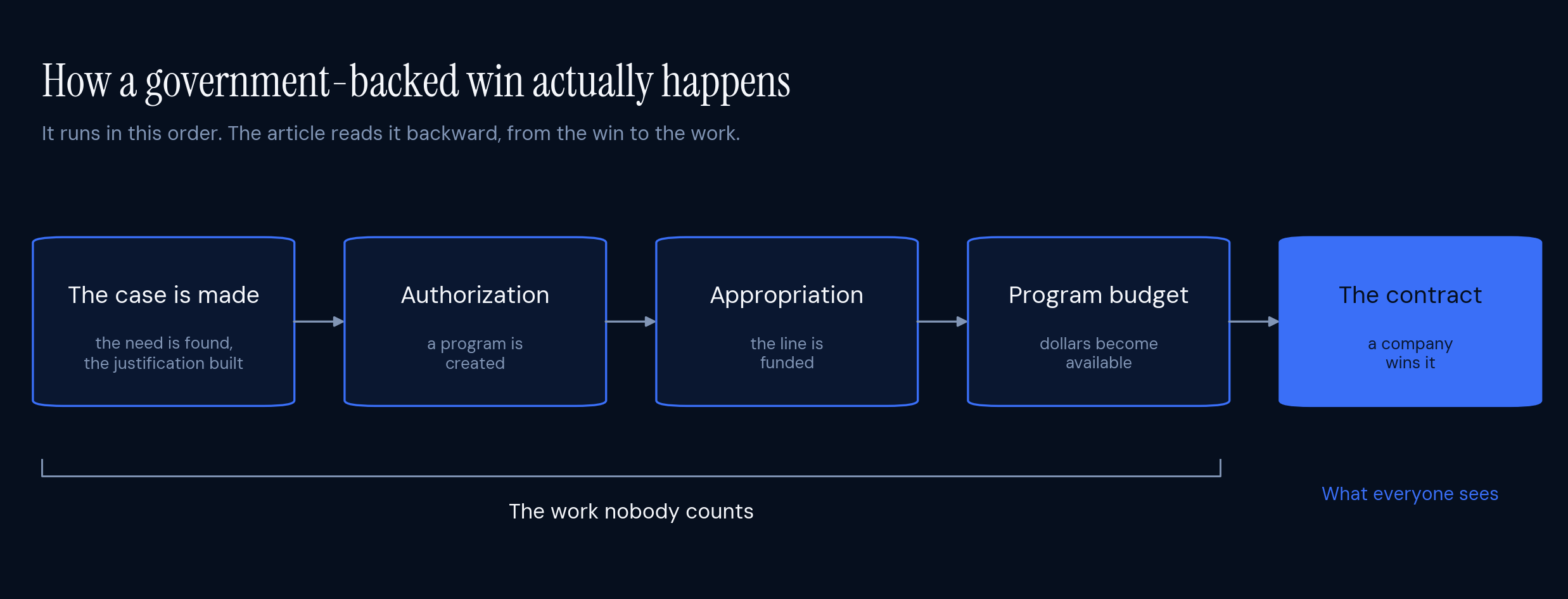
The win is the touchdown. The drive that put the ball there ran off camera, and it was run by people the headline never names. When you only watch the scoreboard, you credit the company that crossed the line and miss the plays that got it there.
Run on Spreadsheets and Memory
Here is what that work looks like, inside the companies that do it well and the teams hired to do it for the ones that do not. Figuring out which agency owns the problem. Mapping the program, its budget cycle, its decision-makers, and its history. Building the submission. Engaging the right offices. Tracking deadlines across appropriations and grant cycles that do not wait. Remembering which argument worked last time, and why.
And in most places, all of it runs on disconnected spreadsheets, email chains, shared drives, static contact lists, and institutional memory held by a few people who are one resignation away from walking out the door with it.
The result is rarely a lack of effort. It is a lack of infrastructure. The body of work that produces a quarter of the country’s billion-dollar outcomes gets treated as overhead, when it is the pathway to the outcome.
That reframing lands hardest for two groups. For the operators who do this work, the 24 percent is not luck and it is not just access. It is the output of a process that can be run well or badly, and most of it is run badly, because it belongs to no system and sits in no one place. For investors, the point is sharper. If government had a hand in a quarter of billion-dollar outcomes, then a company’s capacity to do this work is a real input to where it ends up, not a line at the back of the deck. Commonweal put a price on the outcome, $1.6 trillion. No one has priced the work that produces it, or the value lost by companies that had the technology and never built the capacity to go and get the support.
Not a Defense Story
It would be easy to file all of this under defense and move on. The data does not allow it. Government support showed up most often in the exact sectors everyone is now racing to build in.
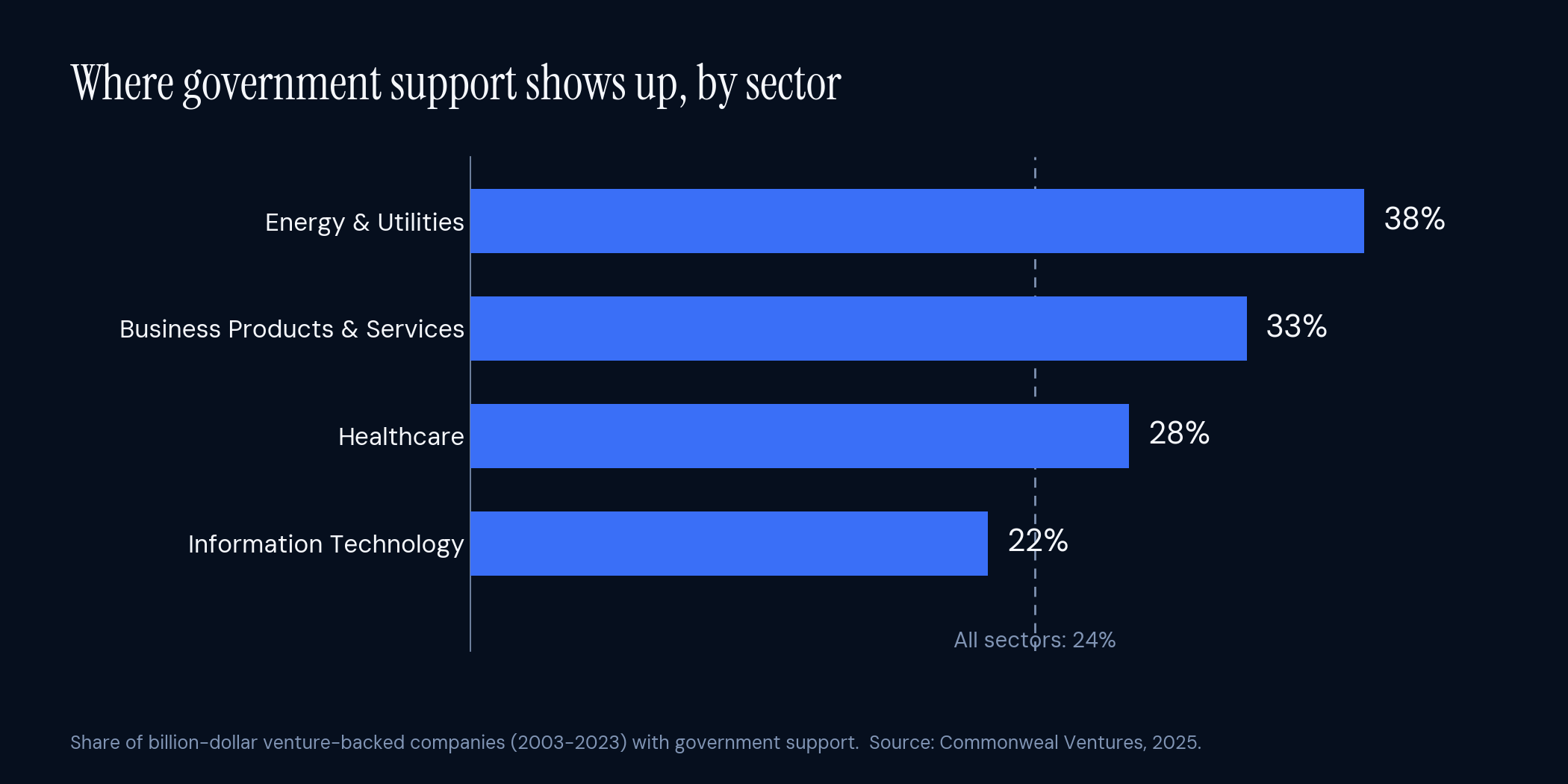
Nearly two in five energy companies. A third of business products and services. More than a quarter of healthcare, and better than one in five in information technology. As more of the frontier runs through government, the work of accessing government stops being a side function and becomes part of building the company. This is not a defense quirk. It is how a growing share of the economy gets built.
The Number Nobody Calculated
The number everyone will quote from here is 24 percent. The number worth thinking about is the one nobody calculated: how much value was never created because the technology was there and the work was not. For every company that found the program and made the case, there is another that had the better product and never learned how the money moves.
So the next time you read that a company won a government market, ask the question the headline skips. Who did the work that made those dollars exist in the first place, and was anyone even keeping track.